6-Month-Old Chihuahua: Weight, Adult Teeth, Spaying and First Heat
Your 6-month-old Chihuahua is about 70% grown. Weight by adult size, retained baby teeth, spay or neuter timing, first heat, adolescence and moving to two meals.

A 6-month-old Chihuahua looks almost like an adult, and that’s exactly why this month catches owners off guard. He’s around 70% of his final weight, his adult teeth should be finishing, and it’s the age when three decisions land on your plate at once: whether and when to spay or neuter, what to do about stubborn baby teeth, and how to handle a puppy who suddenly seems to have forgotten everything he knew.
This guide is general information and does not replace a consultation with your veterinarian, especially on surgery and dental decisions.
Below you’ll find what he should weigh, what to check in his mouth, what the veterinary guidance says about spay and neuter timing, the signs of a first heat, and how meals change from here.
How much should a 6-month-old Chihuahua weigh?
A 6-month-old Chihuahua usually weighs between about 2 lb 2 oz and 4 lb 14 oz (1 to 2.2 kg). At 24 weeks a puppy carries roughly 70% of his adult weight, so dividing today’s weight by 0.7 estimates his final size. A 3.5-pound puppy at 24 weeks will most likely finish close to 5 pounds.
These figures come from the same breed growth curve as our Chihuahua weight calculator. Find his age and see which row today’s weight lands in:
| Adult weight he’s heading for | At 24 weeks (about 70%) | At 26 weeks (about 74%) |
|---|---|---|
| 3 lb (1.4 kg) | 2 lb 2 oz | 2 lb 4 oz |
| 4 lb (1.8 kg) | 2 lb 13 oz | 2 lb 15 oz |
| 5 lb (2.3 kg) | 3 lb 8 oz | 3 lb 11 oz |
| 6 lb (2.7 kg) | 4 lb 3 oz | 4 lb 7 oz |
| 7 lb (3.2 kg) | 4 lb 14 oz | 5 lb 3 oz |
Two things change from here. First, the pace drops: from now to his first birthday he’ll gain roughly what he gained between 3 and 6 months, spread over twice the time. Second, your scale matters more than the chart. If he’s gaining fast but you can no longer feel his ribs with light pressure, he’s getting chubby, not growing. Most Chihuahuas reach adult weight between 9 and 12 months; the full picture, stage by stage, is in our Chihuahua growth stages guide.
Are all the adult teeth in at 6 months?
Almost. According to VCA Animal Hospitals, teething begins at about 3.5 to 4 months and most puppies have all of their adult teeth by 6 to 7 months. The Merck Veterinary Manual gives the same finish line: all 42 permanent teeth in place by about 7 months.
The problem in Chihuahuas is the baby teeth that don’t leave. VCA lists small breeds as more prone to retained deciduous teeth, and says the most common culprits are the upper canines, followed by the lower canines and then the incisors.
How to check at home, once a week this month:
- Lift his upper lip and look at the long fangs on each side.
- Two pointed teeth crammed side by side, one slimmer than the other, means the baby canine is still there next to the adult one.
- Do the same with the lower jaw and the little front teeth.
Why it matters: a retained tooth crowds the adult one, traps food, and leads to tartar, gum disease and, later, worn or fractured teeth. A retained lower canine can push the adult tooth toward the roof of the mouth. VCA’s advice is clear: the extra tooth should come out promptly, under anesthesia, and in most cases it isn’t recommended to wait for the spay or neuter to do it. If the surgery is already booked for the next few days, ask your vet whether combining them makes sense; if it’s months away, don’t hold the tooth hostage to the calendar.
When should you spay or neuter a 6-month-old Chihuahua?
This is the decision most owners face this month. The American Animal Hospital Association (AAHA) publishes a spay and neuter chart that splits dogs by expected adult weight. Every Chihuahua falls in the smallest group:
| Dog expected to weigh under 45 lb | AAHA suggestion |
|---|---|
| Female | Spay before the first heat cycle (5 to 6 months of age) |
| Male | Neuter at 6 months of age |
So for a Chihuahua, 6 months is right in the window. What can move the date for an individual dog:
- A very small puppy. If he or she is tracking the 3-pound row of the chart above, your vet may prefer a few more weeks of growth before anesthesia.
- Retained baby teeth. See above: get them checked now, not on surgery day.
- A heart murmur or abnormal pre-op bloodwork. That changes the plan, not necessarily the decision.
- Low blood sugar risk. Toy breeds don’t tolerate long fasts well; ask how long your puppy should go without food before surgery.
What it costs in the US, how to manage the recovery and why jumping is the real enemy afterward are all covered in spaying a Chihuahua. The point for this month is simply to have the conversation at the 6-month visit, before a first heat makes the choice for you.
Could your Chihuahua have her first heat now?
Yes. VCA Animal Hospitals puts puberty, and so the first heat, at about six months of age, and notes that smaller breeds tend to cycle earlier. In toy breeds it can come at 4 or 5 months, so a 6-month-old female may already have had one you didn’t notice.
The signs VCA describes:
- A swollen vulva, often the first change but easy to miss.
- Bloody discharge, which later turns thinner and pinkish. A tidy 3-pound female may lick it away before you see it.
- Peeing more often, in small amounts, to mark.
- Male dogs suddenly very interested in her.
A heat usually lasts about nine days but can range from 2 to 24 days. Keep her away from intact males the whole time, on a leash outdoors and never alone in the yard. Our guide to the Chihuahua heat cycle covers the four stages, how often heats come and the pyometra warning signs that matter if you decide not to spay.
Males at this age often start lifting a leg and marking, indoors included. Clean every marked spot with an enzyme cleaner so the smell doesn’t invite a repeat, and mention the marking at the neuter conversation.
Why is my 6-month-old Chihuahua acting out?
Because he’s a teenager. Somewhere between 6 and 12 months, a Chihuahua who sat on cue and came when called may start ignoring you, barking at things he used to accept, guarding toys or having indoor accidents after months of success. It isn’t spite and it isn’t permanent. It’s canine adolescence, and in this breed it tends to be loud.
What works:
- Go back a step in training. Short sessions, high-value treats, easy wins. Act as if he’s learning “sit” again.
- Keep the routine boringly stable: same meal times, same walk times, same bedtime.
- Don’t scoop him up every time he barks at the doorbell or another dog. To a sensitive dog, being rescued confirms the thing was scary.
- Never punish fear or reactivity. It makes a small, alert dog more defensive, not less.
- Add mental work: sniff walks now that his vaccine series is done, puzzle feeders, a new trick a week.
If you want to know what comes after adolescence, our piece on Chihuahua personality by age walks through each stage.
How much should a 6-month-old Chihuahua eat?
Two changes happen around now. The Merck Veterinary Manual’s puppy schedule moves from three meals a day (3 to 6 months) to two (6 to 12 months), and the energy your puppy needs per pound starts falling because growth is slowing.
Here’s what our Chihuahua feeding calculator gives on its puppy setting (4 to 12 months), with a typical kibble of 400 kcal per cup:
| Weight now | Calories a day | Cups a day (400 kcal/cup) |
|---|---|---|
| 2 lb | about 130 kcal | about 1/3 cup |
| 2 lb 8 oz | about 154 kcal | about 3/8 cup |
| 3 lb | about 176 kcal | about 1/2 cup (a little less) |
| 3 lb 8 oz | about 198 kcal | about 1/2 cup |
| 4 lb | about 219 kcal | about 1/2 cup (a little more) |
| 5 lb | about 259 kcal | about 2/3 cup |
If you’ve been using the calculator since he was little, you’ll notice something: a 3.5-pound 6-month-old eats about the same daily amount as a 2-pound 3-month-old. The bowl stops growing even though the dog doesn’t. That’s the moment many puppies start getting plump, so recheck the portion every couple of weeks and judge by touch.
A few rules for the switch:
- Drop to two meals gradually: shrink the midday meal over a week while adding to breakfast and dinner.
- A small Chihuahua can stay on three meals longer. If he’s under about 3 pounds or tends to skip meals, ask your vet before cutting one.
- Stay on puppy food until 9 to 12 months, then switch to adult food over 7 days.
- Treats stay under 10% of the day’s calories. Training-heavy adolescence makes this hard; use pieces of his kibble.
What else belongs on the 6-month checklist?
| Task | Why now |
|---|---|
| Vet visit and weigh-in | The vaccine schedule often includes a 6-month booster, and it’s the natural time to plan surgery |
| Check for retained baby teeth | Adult teeth should be in by 6 to 7 months |
| Decide on spay or neuter | AAHA’s window for small dogs is 5 to 6 months |
| Start daily tooth brushing | Adult teeth are in; small mouths crowd and collect tartar |
| Switch from 3 meals to 2 | Growth is slowing |
| Harness, not collar, on walks | A tiny neck and a pulling teenager are a bad mix |
| Keep up flea, tick and heartworm prevention | Dosed for his current weight, which keeps changing |
Watch for one more thing during walks, stairs and play: limping, a skipping step or a leg held up. It’s always worth a vet check in a growing toy breed.
From our house
Romeo is 4 and weighs 5.3 pounds; Lorenzo is 2 and weighs 5.1. Both landed in the 5-pound row of the chart above, which at 6 months corresponds to roughly 3 lb 8 oz. Romeo is the calm, sleepy, sociable one; Lorenzo is electric and alert. Same breed, same size, opposite temperaments, which is a good reminder that adolescence looks different in every dog.
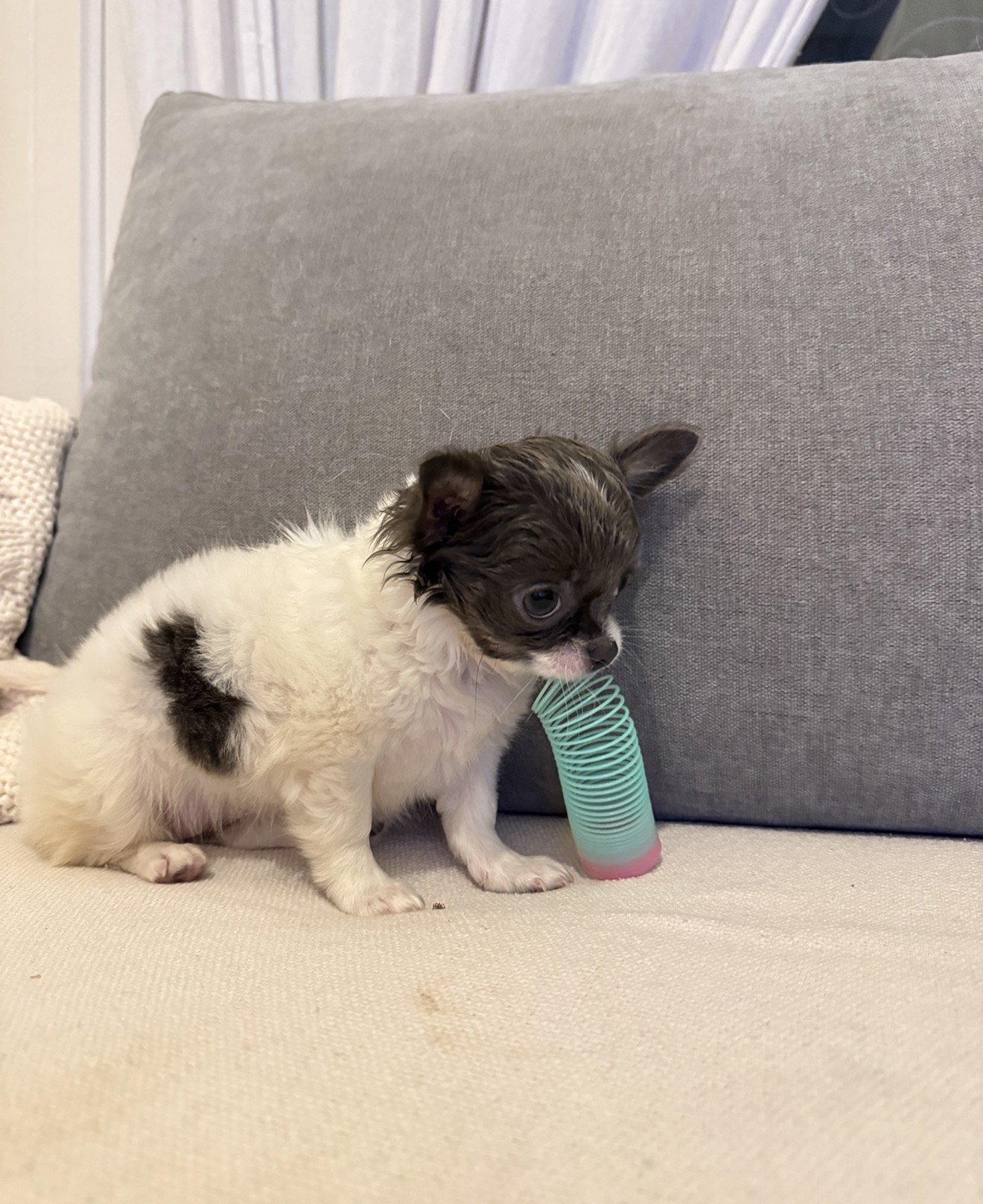
The young Chihuahua in the photo at the top is Mia Mackliff, a club member from Santo Domingo, Ecuador, who joined at about five months old. If yours is turning 6 months this week, book that vet visit, lift his lip and count the fangs, and be patient with the teenager. It’s a phase, and it ends.