3-Month-Old Chihuahua: Weight Chart, Feeding and What to Expect
What to expect from a 3-month-old Chihuahua: weight by adult size, how much to feed, shots due at 12 weeks, teething, sleep, potty training and low blood sugar.
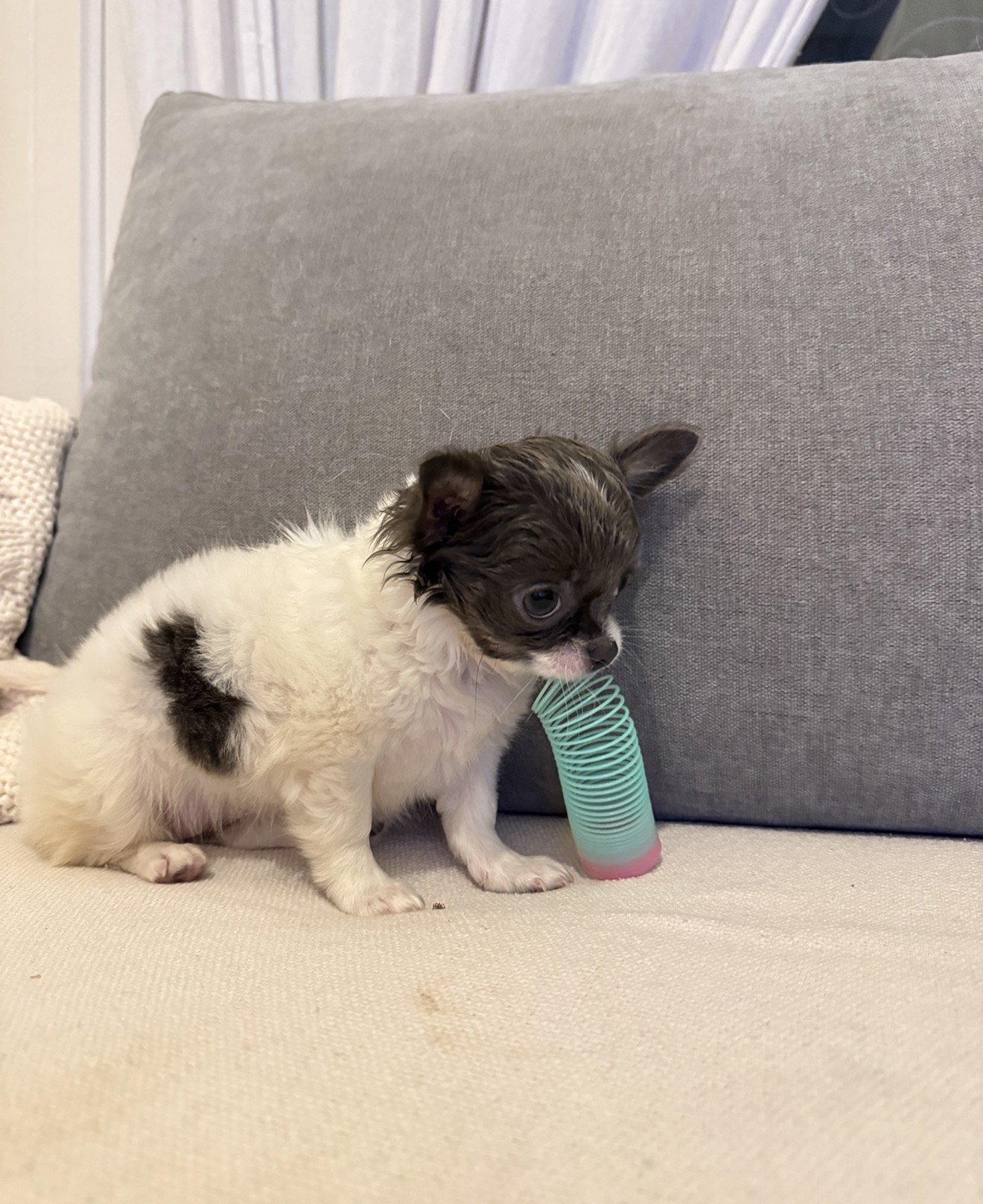
A 3-month-old Chihuahua is a different animal from the fragile little thing of a month ago. At 12 to 13 weeks he’s steadier on his feet, louder, more curious and more opinionated, and he’s also at the point where several big things happen at once: the switch from four meals to three, the last weeks of the socialization window, a vaccine booster and the run-up to teething.
This guide is for general information and does not replace a consultation with your veterinarian. If your puppy seems unwell, call your vet.
Many Chihuahuas also come home at this age rather than at 8 weeks, so if he only arrived this week, start with our new Chihuahua puppy first week guide and come back here. Below you’ll find what a 3-month-old should weigh, how much he eats, which shots are due, what’s happening with his teeth, and the one warning sign you should still keep in mind.
What should a 3-month-old Chihuahua weigh?
A 3-month-old Chihuahua usually weighs between about 1 lb 4 oz and 2 lb 14 oz (570 g to 1.3 kg). At 12 weeks a puppy carries roughly 41% of his adult weight, so a quick estimate of his final size is today’s weight multiplied by 2.5. A 2-pound puppy at 12 weeks typically ends up near 5 pounds.
That range is wide because “Chihuahua” covers adults from 3 to 7 pounds and more. The useful question isn’t whether he’s in range, but which column he’s tracking. These figures come from the same breed growth curve used in our Chihuahua weight calculator:
| Adult weight he’s heading for | Weight at 12 weeks | Weight at 13 weeks |
|---|---|---|
| 3 lb (1.4 kg) | 1 lb 4 oz | 1 lb 5 oz |
| 4 lb (1.8 kg) | 1 lb 10 oz | 1 lb 12 oz |
| 5 lb (2.3 kg) | 2 lb 1 oz | 2 lb 3 oz |
| 6 lb (2.7 kg) | 2 lb 7 oz | 2 lb 10 oz |
| 7 lb (3.2 kg) | 2 lb 14 oz | 3 lb 1 oz |
Three practical rules for this month:
- Weigh him before a meal, on the same kitchen scale, on the same day each week. A full belly can add a couple of ounces, which at this size is a big error.
- Two points beat one. Weigh again at 14 or 16 weeks. If both land in the same column, the projection is solid.
- Watch the trend, not the number. A puppy who stops gaining for two weeks, or loses weight, needs a vet visit even if he still sits inside the table.
If you want the bigger picture, including how fast growth slows after 6 months, the Chihuahua growth stages guide walks through every stage up to the senior years.
How much should a 3-month-old Chihuahua eat?
This is the month when the meal schedule changes. The Merck Veterinary Manual’s puppy care guide gives four meals a day from 6 to 12 weeks and three meals a day from 3 to 6 months, all of them puppy food. For a Chihuahua, 12 to 13 weeks is the handover.
How you make that switch matters more in this breed than in most:
- Spread the same daily total across three meals, don’t just drop one. The amount he needs in a day doesn’t shrink because the number of meals does.
- Keep the gaps even. Breakfast, mid-afternoon and a late dinner works for most households.
- Small puppies can wait. If he’s tracking the 3- or 4-pound column, or he’s ever had a shaky, wobbly episode, ask your vet before giving up the fourth meal.
As for quantity, here’s what our Chihuahua feeding calculator gives on its young-puppy setting (2 to 4 months), using a typical small-breed kibble of 400 kcal per cup:
| Puppy’s weight now | Calories a day | Cups a day (400 kcal/cup) | Per meal, 3 meals |
|---|---|---|---|
| 1 lb 4 oz | about 137 kcal | about 1/3 cup | a scant 1/8 cup |
| 1 lb 8 oz | about 157 kcal | about 3/8 cup | about 1/8 cup |
| 2 lb | about 195 kcal | about 1/2 cup | about 1/6 cup |
| 2 lb 8 oz | about 231 kcal | about 5/8 cup | about 1/6 cup |
| 3 lb | about 265 kcal | about 2/3 cup | about 1/4 cup |
Notice how much that is for his size: a 2-pound puppy eats close to what a 5-pound adult does. Growth is expensive. Two cautions: check the kcal per cup printed on your own bag, because foods vary widely, and use a real measuring cup. At these portions, a heaping scoop can double the meal.
Treats count too. Keep them under 10% of the day’s calories and take them out of the meal portion, not on top of it.
Is a 3-month-old Chihuahua teething?
Not yet, or only just. At 12 to 13 weeks your puppy still has his full set of 28 baby teeth. VCA Animal Hospitals puts the start of teething at about 3.5 to 4 months, and the Merck Veterinary Manual says the 42 permanent teeth usually begin to appear at 4 to 5 months and are all in place by about 7 months.
So the chewing and nipping you’re dealing with now is mostly a baby exploring the world with his mouth. It’s the perfect time to prepare for what’s coming:
- Handle his mouth daily. Lift a lip, touch the gums, reward him. A puppy who accepts this now will accept a toothbrush later, and Chihuahuas need one.
- Offer soft, mini-sized chew toys and swap them in whenever he grabs a hand or a cord.
- Teach “gentle.” If he bites down hard during play, stop the game for a few seconds. A puppy who learns a soft mouth now is much easier to live with later.
Small breeds are prone to keeping baby teeth after the adult ones arrive. You won’t see that until around 6 months, but knowing it now means you’ll check his mouth at every vet visit from here on.
Which shots does a Chihuahua need at 12 to 13 weeks?
Using the common US schedule from our Chihuahua vaccine schedule tool, this is where a 3-month-old usually stands:
| Age | Shot | Where your puppy is |
|---|---|---|
| 6 to 8 weeks | DHPP | Usually done before he came home |
| 9 to 11 weeks | DHPP + leptospirosis | Usually done |
| 12 to 14 weeks | DHPP + lepto booster | Due now |
| 16 weeks | Final DHPP + rabies | Next month (rabies age is set by state law) |
| 17 to 18 weeks | First walk on the ground | A week after the final puppy shot |
DHPP covers distemper, adenovirus, parainfluenza and parvovirus. The Merck manual explains why the series stretches out like this: puppies need vaccines every 2 to 3 weeks until about 4 months, because the antibodies they got from their mother can block a vaccine given too early. Deworming at this age is usually monthly, and your vet will check a stool sample until there are two negative tests in a row.
Ask at this visit about Bordetella if he’ll go to a groomer or boarding, and about when to start a heartworm and flea preventive. With a dog this small, always use the product dosed for his weight; never split a big-dog tablet.
Why do the next two weeks matter so much for socialization?
Because they’re the last of the window. Merck calls socialization important “especially between the ages of 2 and 4 months,” and the window usually cited closes at around 14 weeks. Whatever he meets calmly now, he’ll accept as an adult. Whatever he never meets, he’s likely to bark at.
The catch is that he can’t walk on public ground yet. So socialize from your arms, a carrier or a stroller, and indoors:
- New people every day. Men with beards, people in hats, kids who sit on the floor and stay calm. Let them offer a treat.
- The doorbell and the street. Sit on a bench with him in your lap and let traffic, bikes and buses go by.
- Calm, fully vaccinated adult dogs that you know, in a home or a clean yard.
- Car rides in a secured carrier, ending somewhere pleasant.
- Short spells alone, five to ten minutes, with something to chew. It’s the cheapest prevention for separation anxiety later.
Keep every outing short and finish before he’s overwhelmed. Trembling, a tucked tail or frantic licking means it’s time to go home.
How much does a 3-month-old Chihuahua sleep?
A lot: 16 to 20 hours a day, usually as short naps between bursts of play. That’s normal and he needs it, and a puppy who’s kept awake by kids or visitors tends to get nippy and overexcited.
Nights should be getting easier by now. A small crate or covered bed in your bedroom, a last potty trip right before lights out and one short, boring trip in the night is a realistic goal at 12 weeks. If he’s still crying for hours, check the basics: is he warm enough, did he have a late enough dinner, did he get enough play during the evening?
How do you potty train a 3-month-old Chihuahua?
At this age bladder control is improving but still unreliable, and a Chihuahua’s bladder is tiny even as an adult. Success comes from timing rather than from his self-control:
- Take him to the spot right after waking, after every meal, after play and before bed.
- Pads or a turf patch indoors are fine while he can’t go outside on the ground. If you plan to switch to outdoors later, put the pad near the door.
- Praise and a treat within two seconds of him finishing. Late rewards teach nothing.
- Never punish accidents. Clean them with an enzyme cleaner so the smell doesn’t invite a repeat.
Expect accidents for months, not weeks. With a bladder this small, that’s about size and age, not intelligence.
Is low blood sugar still a risk at 3 months?
Yes. It’s less likely than at 8 weeks, but a 2-pound puppy still has very little in reserve, and the switch from four meals to three is exactly when an episode can sneak in. The signs, roughly in order: unusual sleepiness, trembling that isn’t from cold, wobbling, pale gums, a blank stare and, at worst, a seizure.
If you see them, rub a little honey or corn syrup on his gums, keep him warm and call your vet immediately, even if he perks up. The first-aid steps are laid out in more detail in our 2-month-old Chihuahua guide, which covers the highest-risk weeks.
The best prevention is boring: regular meals, no long gaps, extra care on days with stress, cold or an upset stomach.
When should you call the vet?
- Trembling with wobbling, pale gums or unusual sleepiness: now.
- He refuses two meals in a row.
- Watery diarrhea, blood in the stool or repeated vomiting.
- No weight gain in two weeks.
- A fall from a couch, bed or someone’s arms, even if he seems fine.
- Coughing, discharge from the eyes or nose, or limping.
If anything involving something he swallowed worries you, the ASPCA Animal Poison Control Center is at (888) 426-4435 (a consultation fee may apply).
A note from home
Romeo is 4 now and weighs 5.3 pounds; Lorenzo is 2 and weighs 5.1. Romeo is cream, Lorenzo is fawn, both are apple heads, and both sit right in the 5-pound row of the chart above, which is where a puppy weighing about 2 pounds at 12 weeks usually lands. The calm one and the electric one, as different as two Chihuahuas can be, ended up within a few ounces of each other.
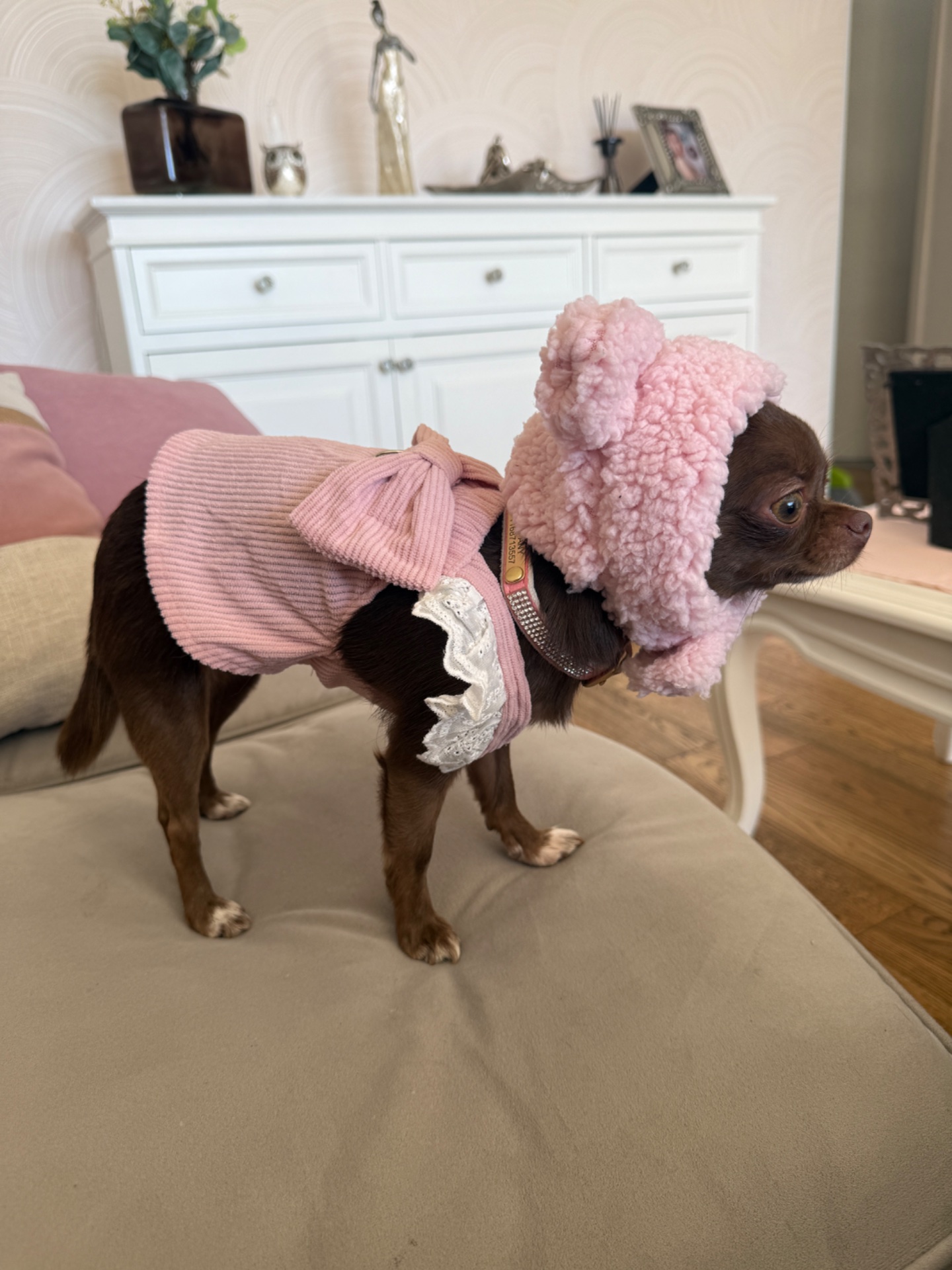
The photo at the top is Teresa, a long coat club member from Bahía Blanca, Argentina, who was about 14 weeks old when she joined the club. If you have a 3-month-old at home, take note of his weight this week and take plenty of pictures: by the time he’s 6 months old, he’ll have nearly doubled.