
2-Month-Old Chihuahua: Weight, Care and What to Expect
Everything about your 2-month-old Chihuahua: how much he should weigh, meals per day, the risk of low blood sugar, vaccines and why he can't go outside yet.
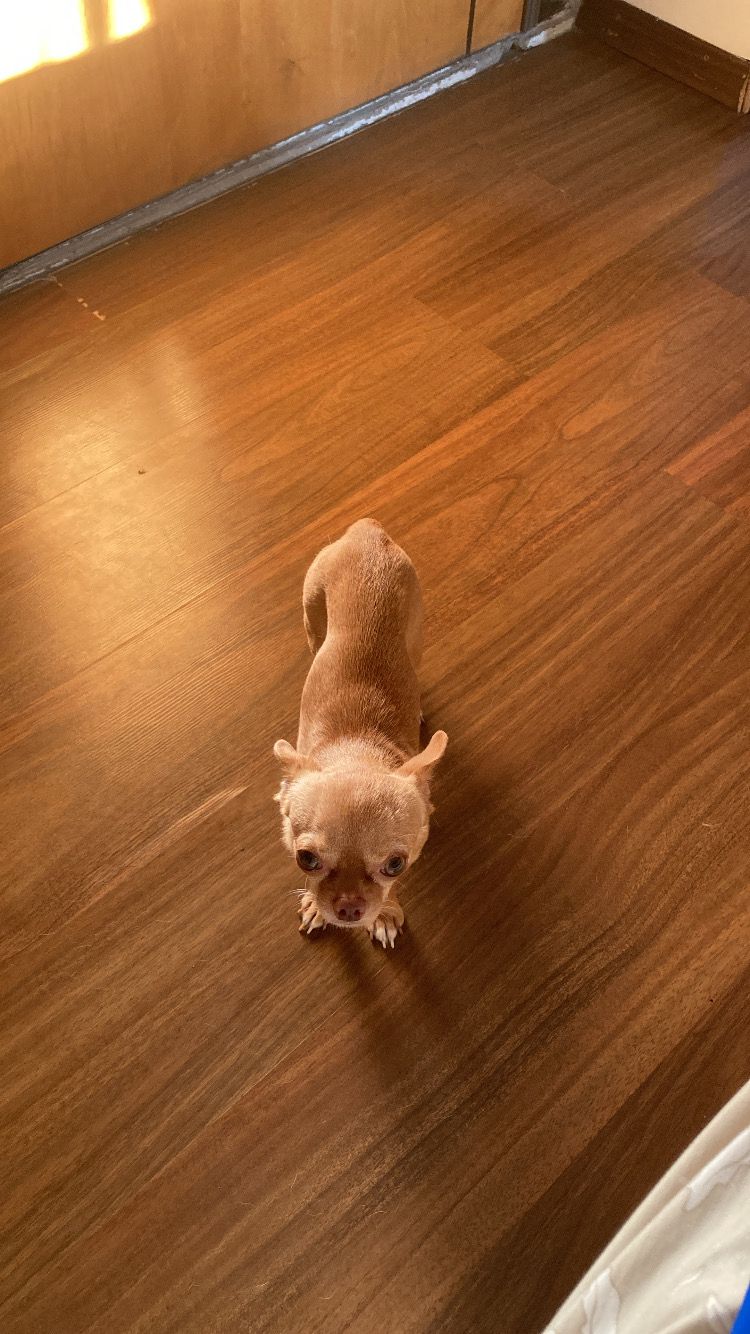
A 2-month-old Chihuahua fits in two cupped hands and often weighs not much more than a can of soup. That’s the first thing to understand, because almost everything else follows from it: at this age the breed has the smallest margin for error of its entire life.
Two months, roughly 8 to 12 weeks, is when most puppies go home with their new families. It’s also the stage with the highest risk of hypoglycemia (low blood sugar), the window when much of his adult personality takes shape, and a time when he still can’t walk on public ground. This guide tells you what to expect week by week this month: how much he should weigh, how much and how often he eats, which vaccines are due, which signs are an emergency, and what you can do today so the adult dog turns out balanced. None of this replaces your veterinarian; it’s here so you know what to watch for and what to ask.
How much does a 2-month-old Chihuahua weigh?
The usual range is 14 to 32 ounces (400 to 900 g), and it’s wide on purpose: a puppy who’ll grow into a 4-pound adult and one who’ll end up at 6.6 pounds weigh very different amounts at the same age.
| Weight at 2 months | Usually becomes an adult of |
|---|---|
| 12 to 18 oz (350–500 g) | 3.3 to 4.4 lb (1.5–2 kg) |
| 18 to 25 oz (500–700 g) | 4.4 to 5.5 lb (2–2.5 kg) |
| 25 to 32 oz (700–900 g) | 5.5 to 6.6 lb (2.5–3 kg) |
| Over 32 oz (900 g) | 6.6 lb (3 kg) or more |
Use it as a rough guide, not a forecast: the parents’ genetics are in charge, and some puppies break the table entirely.
One thing is a rule: weigh him once a week, always on the same day and the same scale (a kitchen scale works). What matters isn’t today’s number but the line it draws. A healthy puppy gains every week. If he stalls for two weeks in a row or loses weight, call the vet, even if he’s still within range.
Hypoglycemia: the one thing that can’t wait
If you remember only one thing from this whole article, make it this.
A 2-month-old Chihuahua has tiny glucose reserves. He has no muscle mass or fat to store energy, and his metabolism runs incredibly fast. The result: he can go from playing to being in trouble within hours if he skips meals, gets very stressed, gets cold or has diarrhea.
The signs, in the order they usually appear:
- Sleepier than usual, hard to wake.
- Shaking that isn’t from cold.
- Wobbling when he walks, as if he were drunk.
- Pale gums, whitish instead of pink.
- A blank stare; he doesn’t respond to his name.
- Seizures or loss of consciousness.
What to do if you see this: rub a little honey, corn syrup or sugar dissolved in water on his gums (not in his mouth for him to swallow, but on the gums, which absorb it directly), keep him warm, and call your vet right then. He usually improves quickly, and that’s deceptive: even if he recovers in minutes, go anyway, because the underlying cause is still there.
Prevention is boring and it works: don’t let him go many hours without eating. That’s the real reason behind four meals a day. Shaking isn’t always this, of course: cold, excitement and fear cause it too. The difference is whether the other signs on the list come with it.
How much and how often does he eat?
The Merck Veterinary Manual is specific for this age: four meals a day between 6 and 12 weeks. After that, it drops to three (3 to 6 months) and then two (6 to 12 months).
The exact amount depends on his weight, and a puppy needs close to three times the calories per pound that an adult does, so don’t eyeball it from the adult guidelines on the bag.
A few details that matter in this breed:
- Puppy food, not adult food. It packs more calories and protein into each bite, which is exactly what a body that can’t eat much volume needs.
- Look for the AAFCO statement on the bag: it means the food meets nutritional standards, and it’s the simplest filter for ruling out poor products.
- Soften the kibble with warm water for the first few weeks. Freshly weaned, dry kibble is hard for him.
- The kibble has to be mini-sized. A large kibble in a 2-month-old jaw is a problem, not a challenge.
- If he refuses more than one meal, don’t let it slide. In this breed, at this age, not eating escalates fast.
Vaccines: why can’t he go outside yet?
If you’d like the exact dates for your puppy, the Chihuahua vaccine schedule builds them from his birth date and lets you add them to your phone’s calendar.
This is the question we get most, and the answer is an uncomfortable one: not yet.
A puppy is born with antibodies from his mother that protect him for a while, but they also interfere with vaccines. That’s why, according to the same veterinary manual, puppies need vaccines every 2 to 3 weeks until about 4 months, when the series is complete. Until then, he should avoid contact with unvaccinated dogs or dogs with an unknown vaccine history.
In practice, at 2 months your Chihuahua is halfway through the series. That means:
- No parks, sidewalks, dog parks or anywhere other dogs have been.
- Yes to being carried, seeing the street from your arms without touching the ground.
- Yes to familiar, adult, fully vaccinated dogs, at home.
The specific reason is parvovirus, which lives in the soil, survives for months, and is merciless in a puppy under 2 pounds.
For parasites the guideline is just as clear: the vet checks a stool sample every 2 to 4 weeks until there are two negative results in a row. A single negative doesn’t settle it, and there’s a technical reason: the veterinary manual notes that the eggs of some parasites may not show up in a test until 16 days after infection.
How do I socialize a puppy who can’t go outside?
This is the real tension of this stage, and most people get it wrong: either they take the puppy out too early, or they keep him shut in with no stimulation until 4 months. Both options have a cost.
The socialization window is closing right now, and whatever he doesn’t meet as a baby will scare him as an adult (the full week-by-week plan, for adults too, is in how to socialize a Chihuahua). The answer is to socialize without exposing him to contaminated ground or unfamiliar dogs:
- Let different people hold him: men with beards, older people, calm kids, people in hats or carrying umbrellas.
- Household noises at low volume: vacuum, hair dryer, doorbell, blender. Start far away and reward calm.
- Different surfaces indoors: carpet, tile, a towel, cardboard. Very smooth wood or tile floors make his paws slip, so put rugs down in his play areas.
- Short car rides, in a carrier, without taking him out.
- Time alone, starting now and in small doses. It’s the best vaccine against future separation anxiety.
- Handling: touching his paws, ears and mouth, trimming one nail. His future vet will thank you.
Keep sessions short and always end on a good note. A big scare at this age leaves a mark.
Household dangers nobody warns you about
A puppy who weighs about 1.3 pounds (600 g) turns your home into a different place:
- Falls. Jumping off the couch or the bed, or slipping out of someone’s arms, is the number one cause of fractures at this age. Never leave him alone on anything high.
- Being stepped or sat on. They get underfoot and you don’t see them. For the first few months, everyone in the house walks differently.
- Slippery floors. Sliding around all day is bad for joints that are still forming.
- The molera. Many Chihuahuas are born with a soft spot on top of the skull that hasn’t fully closed. It’s normal in the breed, but don’t touch or press on it.
- Stairs, gaps between furniture, doors that swing shut.
- Cold. At that size he loses heat incredibly fast, and staying warm burns through his glucose.
Pee, poop and teeth
At 2 months he has no bladder control. Period. (The whole method, from pads to outdoors, is in how to potty train a Chihuahua.) What you do is make it easy for him to get it right: a potty pad or artificial grass always in the same spot, taking him there when he wakes up, after he eats and after he plays, and celebrating when he gets it right. Mistakes are never punished: the only thing that teaches him is to hide when he goes.
It’s normal for his stool to be a bit soft for the first few weeks because of the new home and new food. What isn’t normal is watery diarrhea, diarrhea with blood or diarrhea that lasts more than a day: in a body this small it dehydrates within hours.
He’s also in full baby-teeth mode and chews everything. It isn’t aggression, it’s teething. Give him mini-size chew toys and take whatever doesn’t belong out of his mouth without scolding.
When should you call the vet?
- Shaking, wobbling, pale gums or extreme sleepiness → now (hypoglycemia).
- He skips two meals in a row.
- Watery diarrhea, blood in the stool, or repeated vomiting.
- He fell from a height, even if he seems fine.
- He hasn’t gained weight in two weeks.
- Coughing, sneezing, discharge from the eyes or nose.
- He’s limp, won’t play, doesn’t respond.
If you’re still getting the house ready, our Chihuahua puppy checklist lists what you actually need, with the sizes that fit at this age.
At home
The photo at the top of this article is Lorenzo just after he came home, looking up at me from a wood floor that seemed enormous around him. I remember two things from that time: how little he weighed (today he’s about 5 pounds, and back then he was a fraction of that) and how much he slept. It scared me to see him so still, until I understood that a puppy who sleeps 18 hours is doing exactly his job.
What did test me was the patience with four meals. It seems excessive to split such a small amount into so many servings, and that’s exactly what prevents the serious problem. Romeo, who is eleven now and sleeps on his pillow like a little old gentleman, went through this too, a long time ago. Both made it safely to the other side thanks to boring, repetitive things: eating often, not falling off anything, and meeting the world a little at a time.
If you have a 2-month-old Chihuahua at home right now, this stage is short and flies by. Take pictures: in two months you won’t recognize him.
Frequently asked questions
How much does a 2-month-old Chihuahua weigh?
How many times a day should a 2-month-old Chihuahua eat?
Can I take my 2-month-old Chihuahua for walks?
Why is my Chihuahua puppy shaking?
How much does a 2-month-old Chihuahua sleep?
Written by Belen Salto, who shares her life with Romeo and Lorenzo, two Chihuahuas. · Ver en español