
Chihuahua Temperament: What Nobody Tells You First
Loyal, brave, jealous and deeply attached to one person. The real Chihuahua temperament beyond the memes, before you adopt one.
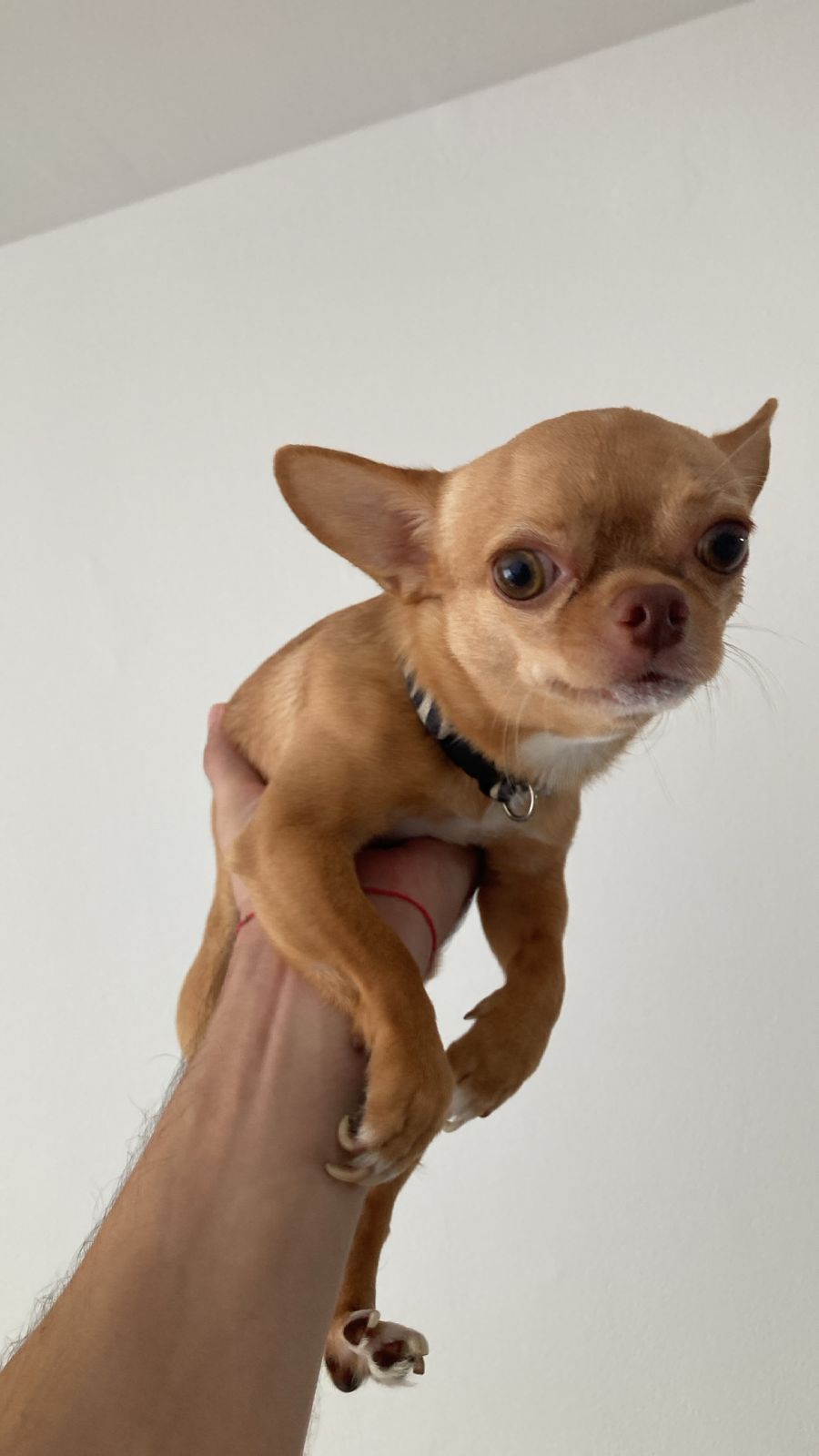
When someone asks me what it’s like to live with a Chihuahua, I always say the same thing: you do not get a dog, you get a bond. It sounds sentimental, but anyone who has shared a home with this breed knows exactly what I mean. The Chihuahua temperament is not “small” in the way a toy poodle is small. It’s an enormous personality packed into two and a half kilograms of dog, and that character has lights and shadows worth knowing before you bring one home.
Let’s bury the myth first
Two opposite versions of the Chihuahua circulate online:
- The social-media version: a cuddly plush toy that fits in your purse, wears pink sweaters and does cute things all day.
- The meme version: a tiny hysterical beast that barks nonstop, bites ankles and hates every living being except its owner.
Neither is true. Or rather, both are caricatures born from the same misunderstanding: people interpret a Chihuahua’s behavior through its size. Because it’s small, it gets treated either as a toy or as a manufacturing defect. The Chihuahua is neither. It is a dog in the fullest sense, with a personality defined from birth and a very particular way of relating to the world.
The five traits that define Chihuahua temperament
1. Deep attachment to one person
If I had to sum up the Chihuahua in a single word, it would be attachment. This breed chooses, and when it chooses, it chooses for life. It doesn’t reject the rest of the family, but there’s one person, usually whoever spends the most time with it, feeds it and stays close during calm moments, that it follows from room to room, sleeps on top of, and seeks out with its eyes when something feels wrong.
It’s one of the most commented-on traits and also one of the least understood. It is not unhealthy dependence, it is an evolutionary strategy. The Chihuahua is vulnerable because of its size, so it anchors to “its human” as a form of safety. Managed well, that attachment becomes a moving kind of loyalty. Managed badly (overprotection, overstimulation, never leaving it alone) it slides into separation anxiety, one of the breed’s most frequent behavior problems. That intense bonding is also why so many owners ask why their Chihuahua follows them everywhere.
2. Wariness toward strangers
A balanced Chihuahua does not greet just anyone. It observes, keeps its distance, evaluates. And if it dislikes a person, it says so plainly: barking, growling, or withdrawing.
To someone used to Labradors or Golden Retrievers, this can look like “bad temperament.” It is not. It is firm character. The Chihuahua carries the natural wariness of small dogs, which in the wild need to stay alert to predators. At home, that alertness becomes social caution. Early socialization (the first 16 weeks of life) softens the reaction a great deal, but the underlying trait remains.
In practice, your Chihuahua will probably take weeks or months to accept a new visitor, and it may never become a dog that is “the life of the party” with everyone. It doesn’t have to be. The key is that it lives that rejection without stress: if it walks away, growls calmly and goes back to its own thing, it’s coping well. If it trembles, hides or bites, there’s work to do.
3. Disproportionate bravery
Chihuahuas have no idea they’re small. They’ll face down a German Shepherd, a stray cat, a vacuum cleaner or a kitchen fan with the same confidence they would use to defend a castle. This comes from the good side of the character: these are dogs with self-esteem.
The problem, of course, is that the bravery is not calibrated. A Labrador somehow knows there are bigger things than itself. A Chihuahua does not. That’s why part of an owner’s job is to protect the Chihuahua from itself: not exposing it to situations where its boldness could get it hurt (parks full of unknown large dogs, rough children, unrailed balconies). Not because it would refuse to go, but because it doesn’t understand the risk.
4. High emotional sensitivity
Few dogs read human mood as well as a Chihuahua. A sad day at home and it appears at your side without being called. An argument and it slips under the table. A celebration and it joins the energy with hops.
This sensitivity cuts both ways:
- In its favor: genuine therapeutic company. It’s no accident that they are popular with people who live alone, work from home, or go through intense emotional periods.
- Against it: a Chihuahua raised in a home of constant shouting, fighting or emotional instability absorbs it all. It becomes anxious, reactive, even aggressive. This is not a dog for chaotic environments.
5. Intelligence with attitude
The Chihuahua doesn’t top the “smartest breeds” rankings (it usually lands mid-table). But that’s misleading, because those rankings measure obedience to human commands. What the Chihuahua has in abundance is adaptive and emotional intelligence. It learns routines in two days. It understands the meaning of dozens of words. It knows perfectly well when you’re scolding it for real and when you are joking.
So why the mediocre obedience score? Because the Chihuahua has its own judgment. If a command seems absurd or ill-timed, it ignores it. That is not disobedience, it is negotiation. Whoever understands this gets a wonderful companion. Whoever expects an automaton that obeys “just to obey” ends up frustrated.
What does this look like day to day?
Living with a Chihuahua is something like this:
- It greets you as if you had been gone a month, licking your face with joy, even if you stepped out for five minutes.
- It follows you to the bathroom and sleeps pressed against you.
- It barks at the delivery person, the neighbor, the elevator and a cat two floors below.
- It proudly ignores the ball you throw, because it doesn’t feel like it.
- It trembles with pure happiness at the sound of its food bag.
- It decides your partner is not to be trusted during the first week. Or adores them from minute one, with no middle ground.
- It curls on your lap through a two-hour movie without moving.
- It stares at you until you decide what to do with your life.
Who is a good fit for a Chihuahua?
It’s not a dog for everyone, and that’s not a flaw in the Chihuahua. It’s the future owner’s responsibility to recognize it.
Good fits:
- People with time at home (remote work, retirement, flexible schedules).
- Calm households, without very young children or with children who understand “it is not a toy.”
- Emotionally stable, patient people.
- People who want an intense bond, not a “decorative” dog.
- People willing to invest in socialization during the first months, without skipping it.
Poor fits:
- Families with children under five or six without constant supervision (to protect both the dog and the child).
- People who spend many hours away with no company alternative.
- People who want an “easy,” uniformly obedient, universally sociable dog.
- Homes with lots of noisy, rotating visitors.
- Anyone who sees a Chihuahua as a purse accessory or status symbol.
The final balance
The Chihuahua’s biggest secret is that it responds to the same equation as any other dog: early education, respect, suitable exercise, mental stimulation, clear limits, abundant affection and consistency. Give it all of that and you have an extraordinary companion for 12, 14, 16 years. And its character doesn’t stand still; it matures with every stage, as I cover in Chihuahua personality by age.
Skip it, and you get the stereotype of the “unbearable Chihuahua.” And it’s almost always a problem with the human, not the dog.
With Romeo and Lorenzo, I learn a new detail about how this breed works every single day. And every day confirms the same thing: they are dogs in capital letters, hidden in a small package. Whoever treats them as such gets the best possible version. If you’re still weighing whether to bring one home, it’s worth reading what to know before getting a Chihuahua before you decide.
Written by Belen Salto, who shares her life with Romeo and Lorenzo, two Chihuahuas. · Ver en español