
Chihuahua Itching and Scratching a Lot: Real Causes and What to Do
Is your Chihuahua itching and scratching nonstop? Parasites, infection or allergy: how to tell them apart, why Benadryl rarely helps and when to see the vet.
If your Chihuahua is itching and scratching a lot, the thump-thump of a back leg against the floor at three in the morning is already part of your life. And the first reaction is usually the same: you part his coat looking for fleas, find none, and are left with no idea what to do next.
Itching (vets call it pruritus) isn’t a diagnosis: it’s a symptom, just like a fever. The Merck Veterinary Manual defines it as an unpleasant sensation in the skin that triggers the urge to scratch, and there can be three very different families of causes behind it. This guide helps you tell them apart, explains why the remedy almost everyone tries first doesn’t work, and tells you when to stop waiting. It is not a substitute for a veterinary visit: it’s here so you arrive at one knowing what to look for.
The three families of causes, in the order vets rule them out
Itchy bald patches are a different thing from a coat that’s been thin since birth: that difference is explained in the hairless Chihuahua.
Vets don’t investigate at random. They follow an order, and knowing it saves you time and money:
- Parasites: mites and fleas. Ruled out first because they’re the most common and the easiest to confirm.
- Infections: bacterial or yeast. They usually come with hair loss, flaking, odor and discharge.
- Allergies: environmental, food or flea bite. Suspected last, once everything above is ruled out.
There’s one detail of the process worth understanding: if the itching continues after a 21- to 30-day course of antibiotics, the manual says an underlying allergy is suspected. In other words, the antibiotic isn’t only treatment; it’s also a diagnostic test. If your vet suggests it, they aren’t shooting in the dark.
How can I tell if it’s fleas, an infection or an allergy?
This table sums up the clues that separate one from another:
| What you see | Points to | The giveaway |
|---|---|---|
| Scratches mostly at the base of the tail and the groin | Flea allergy dermatitis | One bite is enough; you may not see a single flea |
| Intense, sudden itching on the belly, chest, ears, elbows and legs | Sarcoptic mange | Highly contagious, people included |
| One to five small bald patches with little or no itching, in a dog under 1 year | Demodectic mange | Not contagious |
| Hair loss, flaking, bad odor and discharge | Bacterial or yeast infection | The smell is the most reliable clue |
| Licks paws, face and ears; worse in certain seasons | Environmental allergy | The seasonal pattern is the key |
| Itching year-round, sometimes with stomach trouble | Food allergy or environmental | Only confirmed with an elimination diet |
| Dark crusts around the eyes, persistent dandruff | Seborrhea or secondary infection | Usually a consequence, not the cause |
The two kinds of mange are not the same disease
People use one word for both, and they’re two different things. The difference matters because one can affect you and the other can’t:
Sarcoptic mange (scabies). It causes intense itching that comes on suddenly, so strong the dog injures his own skin scratching. It starts on the belly, chest, ears, elbows and legs. It’s highly contagious between dogs, other animals and people. There’s a catch: in very well-groomed, frequently bathed dogs, what the veterinary manual calls scabies incognito can occur, where a skin scraping comes back negative even though mange is there. So a negative result doesn’t always close the case.
Demodectic mange. It’s caused by a mite that already lives on the skin of every dog, and that multiplies when the immune system doesn’t keep it in check. That’s why it isn’t contagious. In its localized form it causes one to five small bald patches, with mild itching or none at all, and it shows up mostly in dogs under a year old. Treatment continues until two consecutive negative skin scrapings, not just until the dog looks better.
Why isn’t Benadryl the answer?
This is the part that tends to surprise people. The first thing many owners do, and the tip that circulates in every dog-owner group, is to give a human antihistamine like Benadryl (diphenhydramine). And the Merck Veterinary Manual is blunt: current research does not support the use of antihistamines to relieve itching in dogs.
Add the usual problem with this breed: working out a dose for a dog who weighs 5.3 pounds, like Romeo, leaves a tiny margin for error. You’d be taking on a risk in exchange for a benefit the evidence doesn’t back up.
What about steroids? According to the same manual, they’re considered the most effective drugs, but they come with their own bill: excessive hunger, thirst and urination, suppressed adrenal gland function, and a higher risk of diabetes and secondary urinary infections. They aren’t a “just in case” option: they’re a veterinary decision with follow-up.
Essential fatty acids (omega-3 and omega-6) rarely work as the only treatment for itching, although they can help over the long term when combined with everything else.
The vicious cycle that explains why he isn’t getting better
If you feel like you treat your Chihuahua, he improves a little and then it starts all over again, there’s a concrete explanation.
Scratching, licking and rubbing break down the skin barrier. Bacteria and yeast get in through those cracks, and a secondary infection sets in that itches on its own. From there the itch keeps itself going: it can continue even after the original cause is resolved.
That’s why treatment often has two fronts (the underlying cause and the infection riding on top of it), and why breaking the cycle early matters so much. The longer he’s been scratching, the more layers there are to undo.
When should I take my Chihuahua to the vet?
There’s no need to rush over an occasional scratch. It is worth booking a visit if any of these show up:
- The itching keeps him up at night (and you too).
- Open sores, scabs or blood from scratching.
- A bad smell from his skin or ears.
- Bald patches that are spreading, or widespread hair loss.
- Skin that’s red, thickened or darkened.
- He shakes his head or scratches his ears persistently.
- Someone at home has started itching too (suspect sarcoptic mange).
- He’s also lethargic, off his food or has digestive problems.
- He’s a puppy, or a senior.
What can you do in the meantime?
Without a diagnosis there’s no treatment, but there are reasonable things that won’t get in the way:
- Keep flea and tick prevention up to date. It’s the foundation of everything, and the first thing your vet will ask about.
- Write down the pattern. Which areas he scratches, at what time, whether it’s year-round or seasonal, whether it got worse after a food change or a move. That log is worth more than any description from memory.
- Take photos of the affected areas, close up and in good light. Skin changes between the day you book and the day you go.
- Don’t switch his food on your own right before the appointment: if an elimination diet comes next, you need to know which proteins he ate before. I explain it in what do Chihuahuas eat.
- Bathe only with a dog shampoo, and don’t overdo it. Human shampoo throws off the pH of their skin.
- Skip homemade cones; if the licking needs to be stopped, let your vet recommend which e-collar or recovery suit to use.
About the elimination diet, two things that save frustration: it lasts weeks, not days, and it requires a protein your dog has never eaten. A single treat outside the plan invalidates the whole trial. And note this: blood and skin allergy tests can’t detect food allergies. The diet is the only real method, and we walk through it in Chihuahua food allergies.
At home
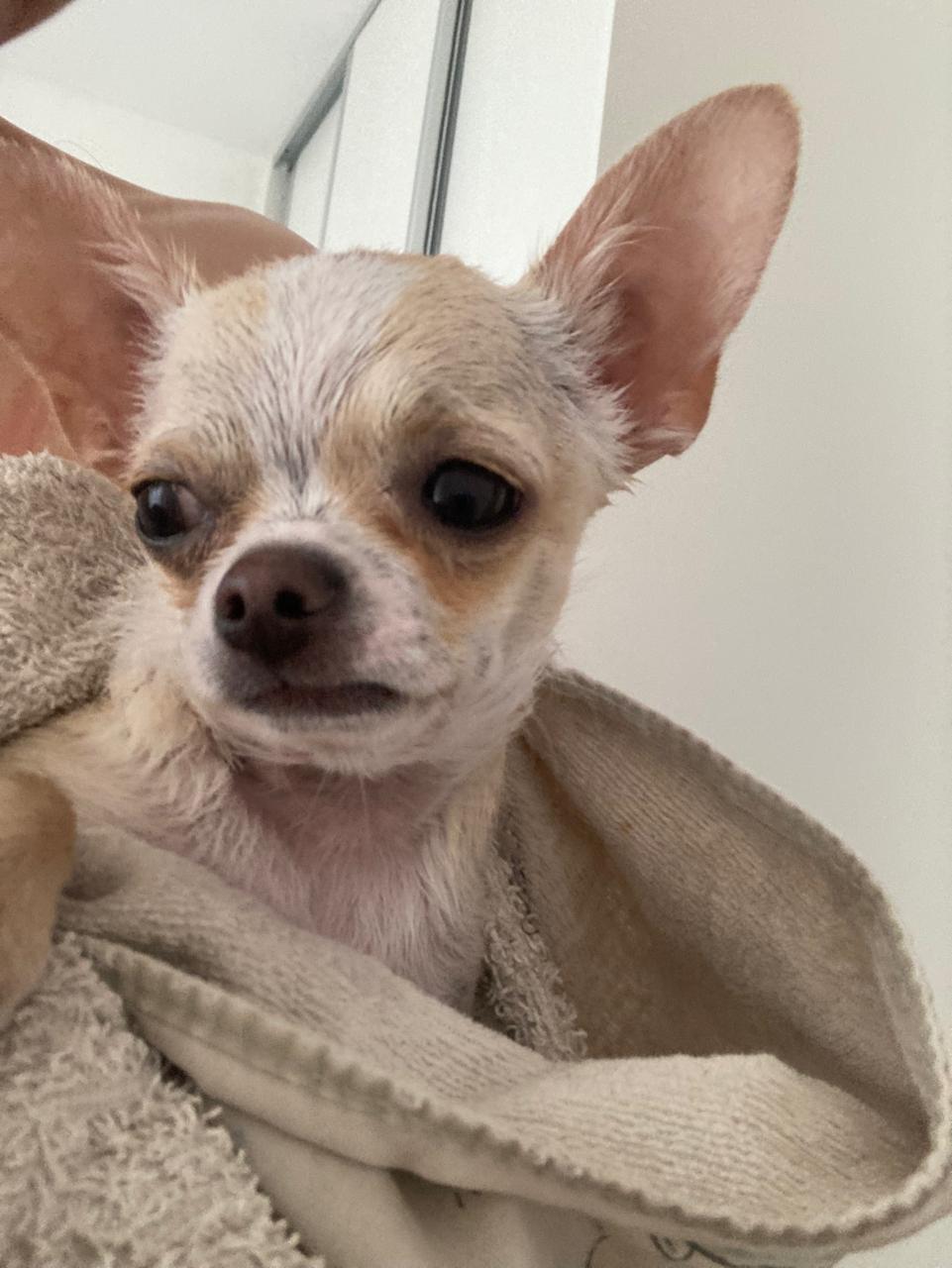
The photo at the top of this article is Romeo fresh out of the bath, wrapped in a towel with that look of offended dignity he always wears. At eleven, his skin is thinner and drier than when he was young, and I learned that bathing him too much does him more harm than bathing him too little.
Lorenzo, who is two and has tougher skin, is the one with the sudden reactions instead: one day a red patch appears on his belly, and three days later there’s nothing left. With him I understood that what you need to watch isn’t a passing scratch, but the scratching that repeats and the scratching that lasts. A Chihuahua who scratches a bit after his nap is just a dog. One who scratches every night for two weeks is trying to tell you something.
And if one thing became clear to me while writing this, it’s that the reflex to give an antihistamine and wait is precisely the one that wastes the most time. That time, with the skin broken and an infection settling in on top, is exactly what turns a simple problem into a long one.
Frequently asked questions
Why does my Chihuahua scratch so much if he doesn't have fleas?
Can I give my Chihuahua Benadryl or another antihistamine?
Can dog mange spread to people?
How long does an elimination diet take to work?
Why is he still scratching after treatment?
Written by Belen Salto, who shares her life with Romeo and Lorenzo, two Chihuahuas. · Ver en español