
Chihuahua Teeth Problems: Gum Disease, Extractions and Baby Teeth
Chihuahua teeth problems explained: the four stages of gum disease, why extractions are common, retained baby teeth and what vets say about anesthesia-free cleaning.
Ask any vet which part of a Chihuahua ages first and most will point to the mouth. Long before the knees or the heart cause trouble, Chihuahua teeth problems tend to show up quietly: a little yellow line at the gumline, breath that changes, a dog that starts chewing on one side. By the senior years, many Chihuahuas have already lost a handful of teeth.
None of that is a reason for panic. It’s a reason to understand what’s happening in there, because dental disease in this breed is predictable, and most of it can be slowed down. This guide walks through how gum disease progresses, why extractions are so common, what to do about baby teeth that refuse to fall out, and the truth about anesthesia-free cleanings.
This article is for information only and is not a substitute for advice from your veterinarian. Only a vet, ideally with dental X-rays, can tell you what’s going on below the gumline.
A big set of teeth in a very small mouth
An adult dog has 42 permanent teeth, whether it’s a Great Dane or a 5-pound Chihuahua. In a toy-breed jaw there simply isn’t enough room for all of them to sit neatly, so teeth overlap, rotate and press against each other. Every one of those tight spots is a place where plaque collects and the toothbrush can’t quite reach.
The MSD Veterinary Manual notes that small-breed dogs usually have more problems with periodontitis than large-breed dogs, and that gum disease is the major reason dogs lose teeth. Add a breed that often keeps its baby teeth too long, and you have the recipe for the most common health problem in the Chihuahua.
How gum disease progresses: the four stages
Plaque is a soft film of bacteria that forms on teeth every day. Left alone, it hardens into tartar (calculus), and the bacteria underneath it start working their way down between the gum and the tooth. That’s where the real damage happens.
The American Veterinary Dental College (AVDC) grades periodontal disease in stages, based on how much of the tooth’s attachment to the jaw has been lost:
| Stage | What’s happening | Reversible? |
|---|---|---|
| PD1: Gingivitis | Red, swollen gums; no loss of attachment yet | Yes, with a proper cleaning and home care |
| PD2: Early periodontitis | Less than 25% of the tooth’s attachment lost | No, but it can be stopped |
| PD3: Moderate periodontitis | 25% to 50% of attachment lost | No; some teeth may need extraction |
| PD4: Advanced periodontitis | More than 50% of attachment lost | No; extraction is usually the kindest option |
The line that matters is between stage 1 and stage 2. According to the MSD Manual, gingivitis can be reversed with proper cleaning and is often first noticed at about 2 years of age, while periodontitis usually begins at 4 to 6 years and is irreversible: the bone and ligament that hold the tooth in place don’t grow back. Everything you do before that point counts double.
Signs your Chihuahua’s teeth hurt
Dogs are experts at hiding mouth pain. A Chihuahua with a rotten molar will usually keep eating, just differently. Watch for:
- Bad breath that doesn’t go away (the most common first sign; Chihuahua bad breath explains what different smells can mean).
- Red or bleeding gums, or a brown crust at the base of the teeth.
- Chewing on one side, dropping kibble or swallowing food whole.
- Pawing at the mouth or rubbing the face on the carpet.
- Drooling, sometimes tinged with blood.
- A loose tooth, or one you can see has shifted.
- Swelling under one eye, which can point to an infected upper tooth root.
- Not wanting the face touched.
Why do Chihuahuas need so many tooth extractions?
This is the part that shocks people when they get the estimate after a dental cleaning: “They took out how many?” In a toy breed with advanced disease, it’s not unusual for a vet to remove several teeth in one procedure, and some senior Chihuahuas end up with very few left.
There’s no fixed number, and you’ll see wildly different figures online. What drives it is simple: by the time a tooth has lost half or more of its bone support, keeping it means keeping a source of pain and infection. The MSD Manual says plainly that extractions are often necessary for dogs with periodontitis, that they let the tissue heal, and that dogs do well without the teeth.
Dental X-rays are what tell the vet which teeth can be saved. The MSD Manual describes jaw X-rays as a normal part of diagnosing periodontal disease and planning treatment, because a tooth can look fine above the gum and be failing at the root.
Eating without teeth
It sounds alarming, but here’s the reassuring truth: a Chihuahua without its back teeth, or even without most of its teeth, can live a completely normal life. Dogs don’t grind their food like we do; most of it gets swallowed in small pieces anyway. What a dog can’t do is eat comfortably with an infected tooth.
After extractions, these adjustments usually help:
- Soften the kibble with a little warm water for 10 to 15 minutes before serving, or switch to a canned food your vet approves.
- Pick small kibble. Many toothless dogs still manage tiny dry pieces without trouble.
- Skip hard chews for the healing period your vet gives you, and keep it gentle afterward.
- Expect the tongue to peek out. With no lower canines to hold it in, some dogs show a little tongue. It’s harmless, and frankly adorable.
If your vet has already mentioned a cleaning with possible extractions, our breakdown of dog teeth cleaning cost covers what’s usually included and how to read the estimate.
Retained baby teeth: a toy-breed classic
Puppies have 28 baby teeth. Between about 4 and 8 months, the adult teeth push up and the baby teeth fall out, often swallowed without you ever noticing. In toy breeds like the Chihuahua, some baby teeth don’t get the message. The vet term is persistent deciduous teeth, though most people say retained baby teeth.
You’ll usually spot them next to the canines: two pointy teeth where there should be one, the thinner baby fang sitting right beside the adult one. They cause two problems:
- Crowding and food traps. Two teeth in one spot create a pocket where plaque and food pile up, so gum disease starts years early.
- Bite problems. A baby tooth that stays in place can push the adult tooth out of its normal position.
The MSD Manual’s advice is clear: removing retained baby teeth as soon as they’re noticed usually prevents later complications. Many vets do it during the spay or neuter surgery, so the puppy only goes under anesthesia once. If your Chihuahua is past 8 months and you can count two teeth in one spot, mention it at the next visit.
Is anesthesia-free dental cleaning a good idea?
It’s tempting, especially with a tiny dog and a worried owner. Some groomers and mobile services offer “anesthesia-free” cleanings: the dog is held still while someone scrapes the tartar off the visible part of the teeth. The teeth look white afterward, and it costs less.
The AVDC doesn’t even like the name. In its position statement on dental scaling without anesthesia, it calls the practice Non-Professional Dental Scaling and considers it inappropriate, for three reasons:
- Safety. Tartar is removed with sharp instruments and power scalers. Even a slight head movement from an awake dog can injure the mouth.
- It misses the disease. The most important part of a cleaning is under the gumline, where periodontal disease is active. The AVDC says access to that area of every tooth is impossible in an awake dog, and that removing visible tartar provides “a false sense of accomplishment.” The effect, in its words, is purely cosmetic.
- The airway. Anesthesia with a breathing tube keeps the dog still and pain-free, and protects the lungs from inhaling water and debris.
Add the fact that nobody can take dental X-rays of a squirming Chihuahua, and you get a clean-looking tooth sitting on a root that may be infected.
Anesthesia in a Chihuahua is a fair worry. But a healthy dog with pre-anesthetic bloodwork, monitored throughout the procedure, is in a very different situation from what most owners picture. If your Chihuahua is a senior or has a heart murmur, ask your vet what extra precautions they take. It’s a reasonable question, and a good clinic will be glad you asked.
Home care that actually works
Professional cleanings fix what’s already there. What happens between them is up to you.
Brushing
Brushing remains the most effective thing you can do at home. The MSD Manual says daily brushing is best, and that for dogs who won’t accept a brush, wiping the teeth with gauze at least every two to three days still removes plaque. Two details that make it easier:
- Only the outside surfaces need brushing. You don’t have to pry the mouth open; lift the lip and brush along the gumline.
- Never use human toothpaste. It isn’t meant to be swallowed. Use an enzymatic paste made for dogs.
A finger brush or the smallest soft brush you can find works best for a Chihuahua mouth. Start with a few seconds on the front teeth, reward, stop. Build up over a couple of weeks.
The VOHC seal
The pet aisle is full of dental chews, water additives and gels that promise fresh breath. The way to separate evidence from marketing is the VOHC seal. The Veterinary Oral Health Council reviews data submitted by manufacturers (it doesn’t test products itself) and grants its seal for plaque control, tartar control or both. A product without it may still help, but nobody independent has checked.
Which VOHC-accepted products suit a 5-pound dog, and which ones we’d pass on, are in what actually prevents tooth loss in Chihuahuas.
Chews and toys to avoid
Hard things can crack small teeth. Skip cooked bones, antlers, hooves and nylon chews that don’t bend when you press a thumbnail into them. A fractured tooth with an exposed nerve is painful and usually ends in an extraction.
A checkup plan for your Chihuahua’s mouth
| Age | What to do |
|---|---|
| 8 to 16 weeks | Start handling the mouth and introduce a finger brush |
| 7 to 8 months | Check for retained baby teeth; remove them if present |
| 1 to 3 years | Daily brushing; first professional cleaning when your vet sees gingivitis |
| 4 to 8 years | Mouth exam at every checkup; cleanings with X-rays as needed |
| 9 years and up | Exam every six months; plan cleanings around bloodwork and heart health |
Dental disease is the first item on our list of common Chihuahua health problems for a reason: it’s the one almost every Chihuahua meets sooner or later.
Tiffany, Romeo and Lorenzo
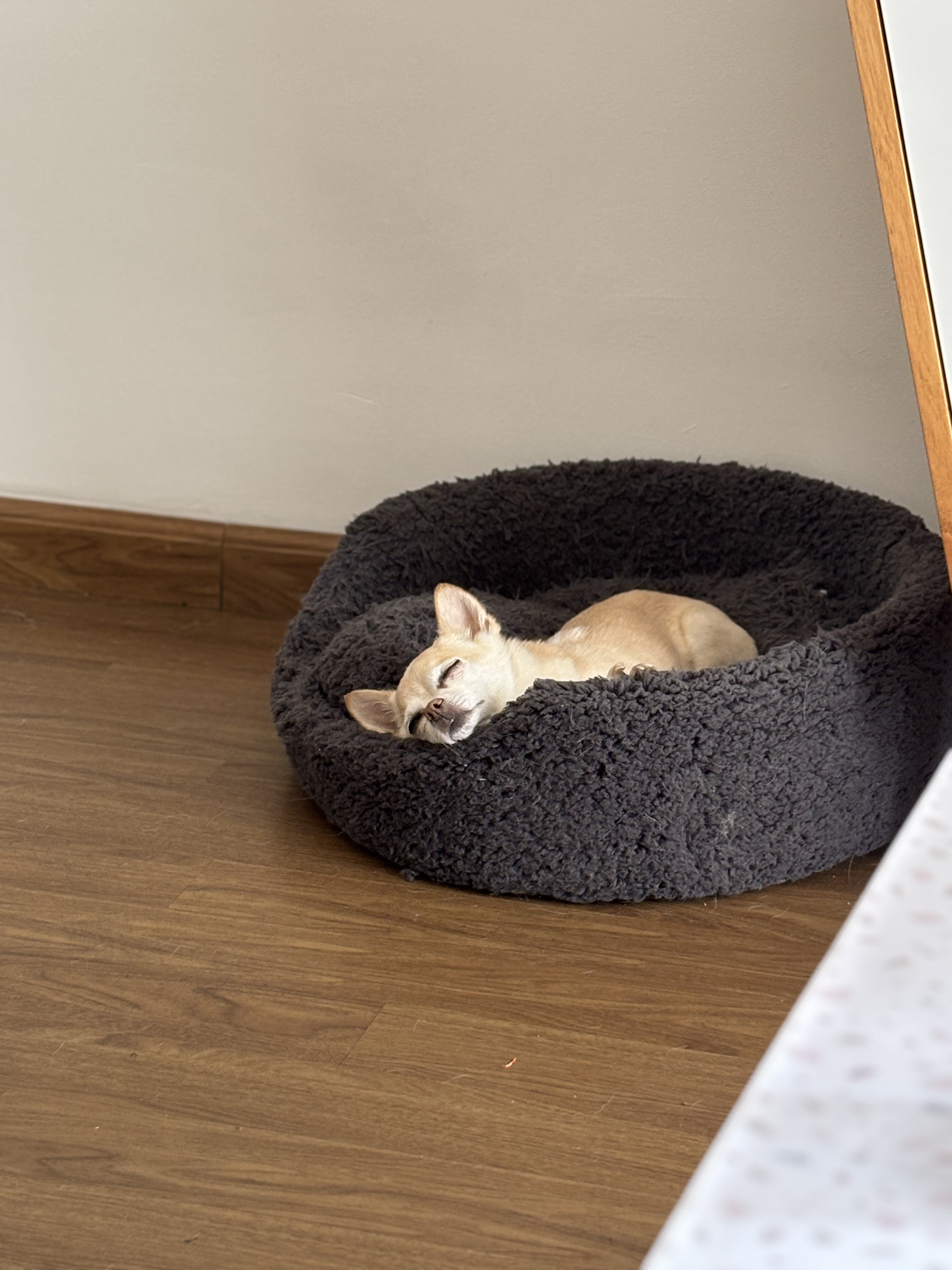
The golden Chihuahua at the top of this article is Tiffany, a club member from Buenos Aires born in January 2012. Fourteen-year-old Chihuahuas don’t happen by accident, and for most of them a looked-after mouth is part of how they get there.
At home we have both ends of the timeline. Romeo is 11, at the age where the vet spends a little longer looking in his mouth at every visit. Lorenzo is 2, right at the age when gingivitis usually first appears, which is exactly why the habits matter now. Two dogs, two very different mouths, and the same idea for both: the toothbrush is cheaper than the extraction.
Frequently asked questions
Why do Chihuahuas have so many teeth problems?
Can a Chihuahua live and eat without teeth?
Is anesthesia-free teeth cleaning safe for a Chihuahua?
What are retained baby teeth and should they be removed?
How often should I brush my Chihuahua's teeth?
Written by Belen Salto, who shares her life with Romeo and Lorenzo, two Chihuahuas. · Ver en español