
Common Chihuahua Health Problems: 8 Conditions to Know
The most common Chihuahua health problems: teeth, knees, heart, trachea, low blood sugar and more. When each one shows up, what to watch for and when to see the vet.
When people bring home a Chihuahua, they almost always ask the same thing: is this an unhealthy breed? The answer is no. Chihuahuas are one of the longest-lived dog breeds, with a typical lifespan of 14 to 18 years. But they do have common health problems that show up more often than in other breeds, and knowing them is what separates a scare from a serious problem. Most Chihuahua health issues send a warning first: bad breath, a skip in the step, a strange cough. The trick is knowing what to look for.
This guide covers the eight Chihuahua health problems we see most often in the club, the life stage when each tends to appear, the sign that should catch your attention and how urgent it is. Each one has, or will soon have, its own full article.
This article is for information only and is not a substitute for advice from your veterinarian.
Chihuahua health problems at a glance
| Condition | When it usually appears | Sign to watch for | Urgent? |
|---|---|---|---|
| Dental disease | From 2-3 years | Bad breath, tartar, bleeding gums | No, but don’t put it off |
| Luxating patella | Before the first birthday | A skip on one back leg | No |
| Mitral valve disease | From 7-8 years | Cough, tiring easily, fast breathing while asleep | Depends on the stage |
| Collapsing trachea | Adults and seniors | Dry, goose-honk cough | Yes, if breathing is hard |
| Hypoglycemia | Puppies under 3 months | Limp, wobbly, cold body | Yes, always |
| Hydrocephalus | Puppies | Very domed head, bumping into things, circling | See the vet soon |
| Eye problems | Any age | Tearing, red eye, squinting | Yes, if painful |
| Obesity | Adults | You can’t feel the ribs | No, but it worsens everything else |
1. Dental disease: the most common of all
A Chihuahua has the same 42 teeth as a big dog, crammed into a tiny mouth. The result is fast tartar, inflamed gums and, over the years, loose teeth. Cornell’s Riney Canine Health Center describes periodontal disease as one of the most common conditions in dogs, and small breeds are the most exposed.
The first sign is the breath. If your Chihuahua’s has changed, Chihuahua bad breath covers the causes and what to do. If your vet has already mentioned a cleaning under anesthesia, dog teeth cleaning cost explains the procedure and what it runs.
2. Luxating patella: the skip
This is the signature orthopedic problem of toy breeds. The kneecap slips out of its groove, and the dog hops a few strides on three legs, kicks the back leg out and carries on. Most cases are mild and are managed without surgery, through ideal weight and no jumping off furniture. Grades, when to operate, costs and home care are in luxating patella in Chihuahuas.
3. Mitral valve disease: the senior Chihuahua’s heart
It’s the most common heart disease in small dogs and the leading cause of death in older Chihuahuas. The valve between two chambers of the heart slowly thickens and stops closing properly. The MSD Veterinary Manual describes it as a degenerative disease that progresses over years.
The first thing to appear is a heart murmur, which your vet can hear with a stethoscope long before there are symptoms. That’s why a yearly listen from age seven is worth its weight in gold. Once the heart starts to enlarge, there’s a medication shown to delay heart failure: we explain it in pimobendan for dogs (Vetmedin).
One thing you can measure at home: count breaths per minute while your dog sleeps. More than 30 a minute, consistently, is a reason to call the vet in a dog with a murmur.
4. Collapsing trachea: the goose honk
The rings of cartilage that hold the windpipe open weaken and flatten, especially with excitement, pulling on the leash or heat. The sign is unmistakable once you’ve heard it: a dry cough that sounds like a honking goose.
The number one fix is simple: a harness, never a collar. A collar presses right on the trachea every time the dog pulls. Our picks are in the best Chihuahua harness. If the cough comes with bluish gums or labored breathing, it’s an emergency.
Don’t confuse it with reverse sneezing: short bursts of loud, inward snorting with the neck stretched out. It looks alarming and is almost always harmless. It’s getting its own article soon.
5. Hypoglycemia: the puppy emergency
A Chihuahua puppy has so little energy in reserve that a few hours without food, a chill or the stress of a trip can drop blood sugar far enough to cause seizures. It’s the classic emergency in baby Chihuahuas, especially under 12 weeks. Signs, first aid with honey on the gums and prevention are in hypoglycemia in Chihuahua puppies.
6. Hydrocephalus and the open molera
Many Chihuahuas are born with an open molera (the soft spot on top of the skull), and often it causes no trouble at all. Hydrocephalus is different: excess fluid inside the skull that presses on the brain. The MSD Veterinary Manual lists it among the congenital nervous system disorders, more frequent in toy and dome-headed breeds.
Signs show up in puppies: a very domed head, eyes that point down and outward, clumsiness, bumping into things or circling, a puppy that learns more slowly than its littermates. Any of these deserves a vet visit. How head shape relates to the molera is covered in apple head vs deer head Chihuahua.
7. Eye problems
A Chihuahua’s big, prominent eyes take more hits: they get bumped, dry out and tear up. The most common issues are tear staining, dry eye and corneal ulcers. Chronic tearing is more of a nuisance than a disease, and we cover it in Chihuahua tear stains.
The rule that keeps you safe: an eye that’s squinting, red or has a white spot is an emergency. An ulcer can get worse within hours.
8. Obesity: the one that makes everything worse
It isn’t a breed disease, but it’s the most common problem in house Chihuahuas. One extra pound on a 5-pound dog is 20% overweight, and that loads the knees, squeezes the trachea and makes the heart work harder. If you’re not sure your Chihuahua is at a healthy weight, the is my Chihuahua overweight? tool gives you a body condition score in a minute.
Is pet insurance worth it for a Chihuahua?
It depends on your savings more than on the breed. Most of the problems above are cheap to catch and expensive to fix: a patella surgery runs about $1,500 to $4,000 per knee in the US, and a dental cleaning with extractions or a cardiology workup can each pass $1,000.
Two things matter more than the brand of the policy. First, enroll young: anything diagnosed or showing signs before coverage starts is usually excluded as pre-existing, and Chihuahuas show knee and dental issues early. Second, read the waiting periods: some insurers apply a longer one to knee and ligament conditions. If you’d rather self-insure, a dedicated savings account with a few thousand dollars does the same job for a breed this small.
How do you prevent Chihuahua health problems?
Not all of them can be prevented, but nearly all can be caught early with five habits:
- A full yearly checkup for adults (mouth, knees, heart and eyes), and every six months from age 10.
- Dental care: brushing several times a week and professional cleanings when your vet recommends them.
- Ideal weight, with ribs you can feel without pressing.
- A harness instead of a collar, and stairs or a ramp for the furniture.
- Frequent meals for puppies, and a bottle of honey in the first-aid kit until four months of age.
If your Chihuahua is past ten, the full plan for that stage is in senior Chihuahua care, and what all of this means for lifespan is in how long do Chihuahuas live.
When is a symptom an emergency?
Some signs can’t wait until tomorrow. Go to the vet right away if your Chihuahua:
- Is limp, cold or shaky and is a puppy that hasn’t eaten in hours.
- Has pale, bluish or gray gums.
- Is breathing hard, with an open mouth or using the belly.
- Has a seizure or collapses.
- Is squinting, or has a red, painful eye.
- Vomits several times in a row or has bloody diarrhea.
- Ate chocolate, grapes, xylitol or any human medication.
A club member who’s 18
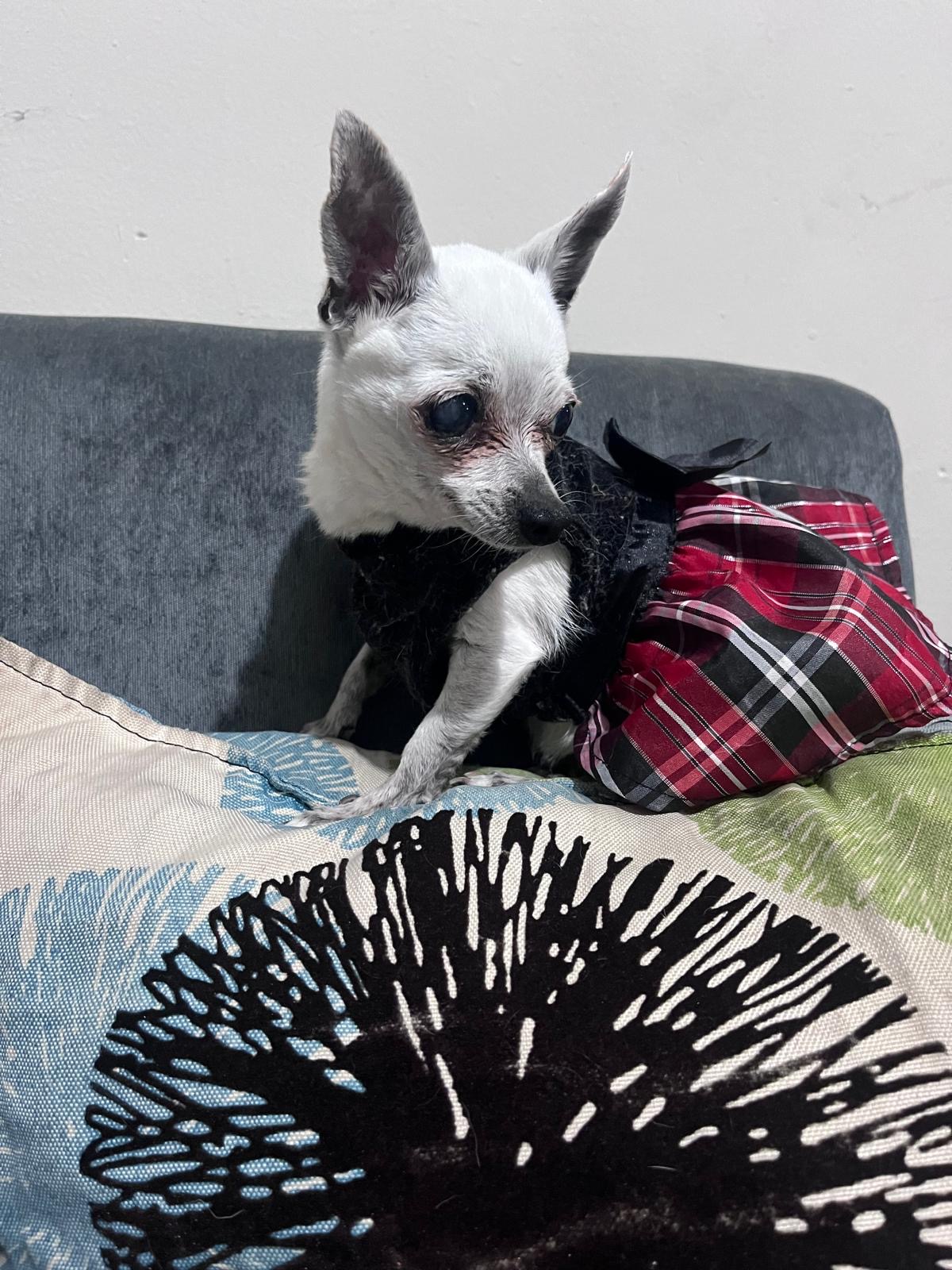
The Chihuahua in the photo is Kiki’s Michelle, a club member from Monterrey, Mexico, born in April 2008. She eats a special diet and lives a quiet life at home. Eighteen years isn’t luck: it’s checkups, care and a family that pays attention to the signs.
Romeo is 11 and Lorenzo is 2, so our house covers both ends of the table above. With Lorenzo we watch knees and weight; with Romeo, heart and teeth. The list changes with age. The idea stays the same: know the signs before you need them.
Frequently asked questions
What are the most common health problems in Chihuahuas?
What do Chihuahuas usually die from?
Are Chihuahuas an unhealthy breed?
How often should a Chihuahua see the vet?
Why does my Chihuahua honk like a goose?
Written by Belen Salto, who shares her life with Romeo and Lorenzo, two Chihuahuas. · Ver en español