
Chihuahua Tear Stains: Causes and How to Clean Them
Why your Chihuahua has watery eyes and reddish tear stains under the eyes, how to clean them safely step by step, and how to prevent them coming back.
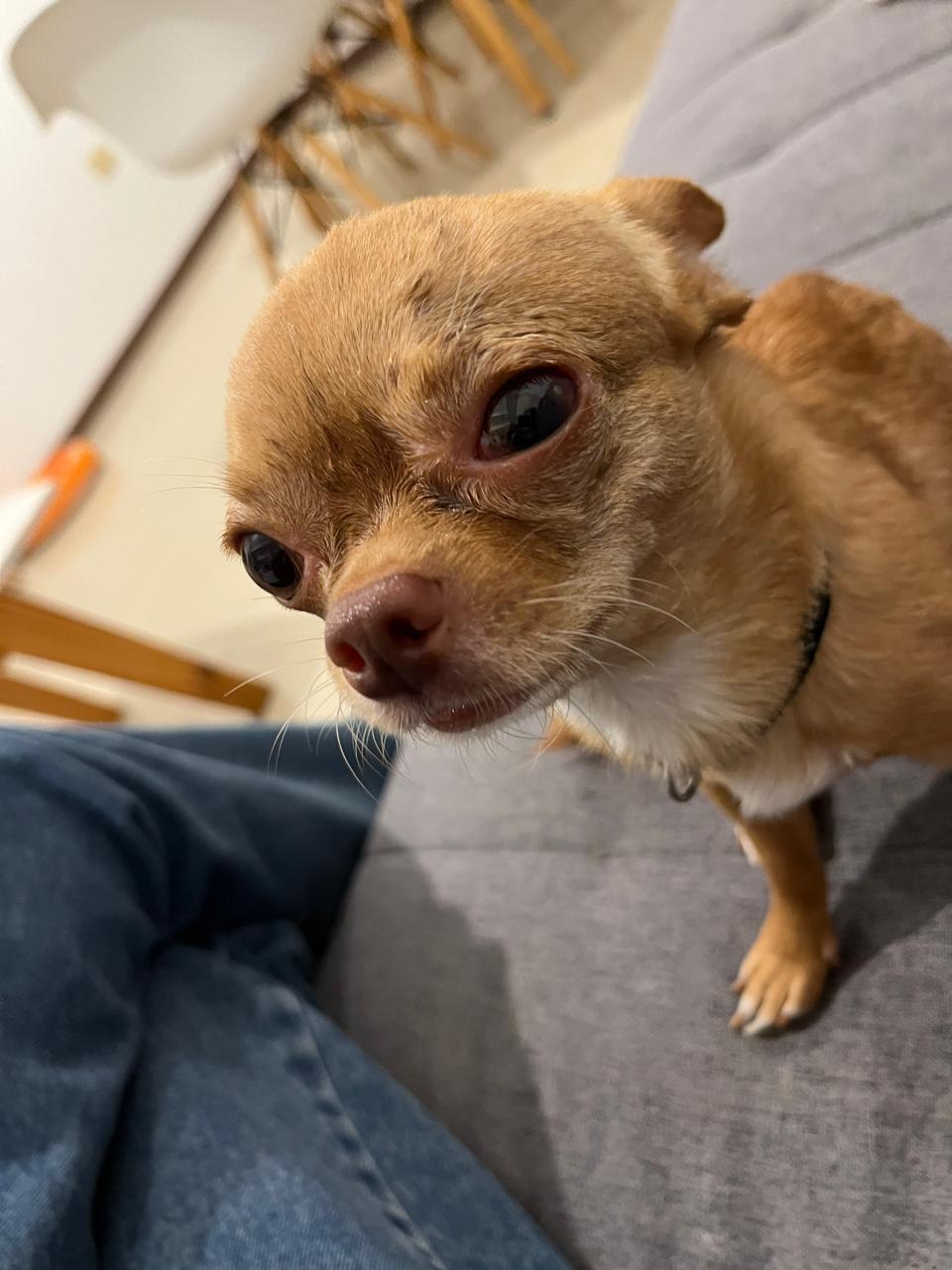
If you’re dealing with daily Chihuahua tear stains, take a breath: it’s one of the most common questions I get, and it almost always has an explanation and a fix. A thin line of moisture under the eye is not a disease, but constant tearing, with brown stains or a red eye, does deserve your attention and, very often, your vet’s.
Why this breed tears up more than others
Chihuahuas have an expressive face that is also anatomically peculiar. Their large, prominent eyes, which the American Kennel Club’s breed description counts among the breed’s signature features, bulge a little more than usual, the eyelids are small, and the tear duct that should drain the tear toward the nose is naturally narrow. Add that apple head Chihuahuas have a rounded skull and a short face, and the outcome is predictable: plenty of tears get produced but find no exit, so they roll down the cheek.
In deer head lines, with a longer muzzle, drainage tends to work better. At home I have both Romeo and Lorenzo as apple heads. Romeo, cream and senior, has always teared a little every day; Lorenzo Pablito, fawn and young, barely leaves a trace. Anatomy rules.
Is it normal for my Chihuahua to have watery eyes?
A healthy Chihuahua may have some moisture in the inner corner on waking, after a windy walk, or with pollen in the air. That tear, if it’s clear, free of pus, and dries quickly, is within the expected range. We talk about excessive tearing when the cheek is permanently wet, brown stains appear under the eyes, the eye looks irritated, or the discharge turns yellowish or greenish.
The medical term for that excess tearing is epiphora, and it’s a symptom, not a disease: it tells us something is off, either because too much tear is produced, because it does not drain, or because there is inflammation.
The most common causes of tearing
Let’s run through them one by one so you can read the signs before calling the vet.
1. Environmental irritation
Smoke, dust, air conditioning blowing directly, heaters, cleaning products, perfumes, air fresheners. All of it irritates the eye and triggers defensive tearing. It’s the silliest cause and, even so, the most common.
2. Eye allergies
Pollen, dust mites, some foods, new fabrics in the bed, detergents. Eye allergies cause itching, red eyes, and tearing in both eyes. You usually see the dog scratching its face or rubbing its muzzle against the sofa.
3. Blocked tear duct
If the channel carrying the tear from eye to nose is narrow or clogged, common in short-faced Chihuahuas, the tear overflows even though the eye is healthy. This is a structural cause, not an infection.
4. Foreign object in the eye
A loose eyelash, a blade of grass, a seed, sand, even a hair from the bangs grazing the cornea. A foreign object causes sudden tearing, constant blinking, and sometimes the dog rubbing with a paw. It warrants a quick check.
5. Hairs rubbing the cornea
Long-haired Chihuahuas can have tufts near the eye that brush the corneal surface and act as a permanent irritant. There’s also a condition called distichiasis, where lashes grow in a row that should not touch, and it usually needs an ophthalmology assessment.
6. Conjunctivitis
Conjunctivitis, inflammation of the pink membrane around the eyeball, comes with a red eye, yellow or green discharge, a swollen lid, and lots of tearing. It can be viral, bacterial, allergic, or mechanical. It needs specific veterinary treatment.
7. Dry eye (keratoconjunctivitis sicca)
Paradoxically, an eye that produces too little good-quality tear can also look wet, because it reacts by overproducing a poor-quality watery tear. Dry eye is more frequent in small breeds and is usually detected by the vet with a simple test called the Schirmer test.
8. Glaucoma and corneal ulcer
Two ophthalmic emergencies, and the MSD Veterinary Manual’s guide to eye disorders in dogs treats both as conditions where hours matter for saving vision. Glaucoma comes with pain, a very red eye, a dilated pupil, a sometimes-bluish cornea, and heavy tearing. A corneal ulcer appears after a blow, a scratch, or an infection, and shows up as intense blinking, constant tearing, and a dog who does not want its head touched. With either one, see the vet the same day.
How to tell harmless tearing from worrying tearing
This is the table I use as a quick reference before deciding whether to call the vet.
| Sign you observe | Possible cause | Action |
|---|---|---|
| Morning moisture, clear, one side | Waking up or a loose lash | Clean and watch |
| Constant tear, both eyes, no redness | Structural epiphora or allergy | Non-urgent consult |
| Red eyes, itching, dog rubs | Allergy or conjunctivitis | Vet visit this week |
| Yellow or green discharge | Bacterial infection | Vet visit soon |
| Closed eye, lots of tearing, pain to touch | Ulcer or foreign object | Same-day emergency |
| Very red eye, odd pupil, dull dog | Suspected glaucoma | Immediate emergency |
| Fixed brown stains, no redness | Chronic oxidized tear | Cleaning routine and review |
How do you remove the brown stains under the eyes?
The famous brown stains under the eyes come from the oxidation of porphyrin, a pigment in the tear. When the hair stays damp for many hours, porphyrin oxidizes in the air and dyes the hair a reddish or brown tone. It’s not dirt; it’s chemistry.
The strategy to remove them has two parts: reduce the underlying tearing by treating the cause, and keep the area dry and clean. Without the first step, the second is a losing battle.
And here’s the part the product labels won’t tell you plainly: nothing removes a stain that’s already in the hair. The pigment is dyed into the strand. What cleaning does is stop new staining, and the stained hair leaves when it grows out and gets trimmed — weeks, not days.
Angels' Eyes textured eye wipes
★ 4.1 · 24,371 valoraciones
Pre-moistened textured wipes for the daily pass under the eye, which is the only part of this that actually works. The texture matters: it lifts the crusted discharge that a cotton pad just smears around, and the pre-moistened format means you're not improvising with water and a tissue every morning.
Ojo: That 4.1 is honest and worth reading correctly. The recurring review is 'cleans well, doesn't whiten' — which is exactly right, because no wipe can bleach dyed hair. Buy it to prevent the next stain, not to erase the current one. Reviewers also warn the foam can run into the eye, so wipe outward and don't soak the area.
Check the eye wipes on Amazon →A daily cleaning routine, step by step
Here is the routine I follow at home with Romeo, who needs it most. It takes under a minute per eye and makes all the difference.
- Wash your hands before touching the dog’s face.
- Sit at his level, with the Chihuahua in your lap or facing you, calm.
- Wet a sterile gauze pad (one per eye, never the same one) with veterinary saline or a solution made for canine eye hygiene.
- Wipe from the inner corner outward, gently, without rubbing. Repeat with a fresh pad if needed.
- Dry the area with another clean pad, dabbing. Residual moisture is what oxidizes the porphyrin.
- Trim hairs falling over the eye with blunt-tipped scissors, if they are long.
- Reward the dog when you finish: positive association, always.
Done once or twice a day, this routine keeps the stain from setting in and keeps the area comfortable.
What you should NEVER use
There are plenty of home remedies floating around online, and almost all of them are a bad idea near a canine eye.
- Homemade chamomile: it can get contaminated, trigger an allergy, and is not sterilized. Veterinary ophthalmologists advise against it.
- Human saline from the first-aid kit: its composition does not always match veterinary eye solution; use it only if your vet says so.
- Peroxide, alcohol, or hydrogen peroxide: never near the eye.
- Leftover human eye drops: the formula can be toxic to a dog.
- Scented or baby wipes: they contain preservatives and fragrances that irritate the mucosa.
- Cotton swabs near the eyeball: very high risk of scratching the cornea.
If you want a product beyond saline, ask your vet. There are specific cleaning solutions that are very gentle, designed precisely for this area.
Hygiene, diet, and genetics: the trio that makes the difference
Tearing is mostly anatomy and a little diet. Very hard water, certain dyes in treats, and chronic stress can all increase porphyrin. Switching to filtered water, reviewing the kibble she eats, and reducing daily anxiety all help. If your Chihuahua is a puppy, it is worth reading the Chihuahua puppy care guide to set up eye hygiene from day one. And if you want to understand why the shape of the head matters so much here, see my article on types of Chihuahua, where I explain the difference between apple head and deer head and its effect on tearing.
When to see the vet without delay
Call your clinic the same day if you notice any of these:
- Closed eye or constant blinking.
- Intense redness or very prominent vessels.
- Yellow, green, or bloody discharge.
- Unequal pupils between one eye and the other.
- Bluish or whitish cornea.
- A lump or deformed eyelid.
- Pain when you touch the head, or mood changes.
- Tearing that appears suddenly after a walk (suspect a foreign object).
If tearing persists more than two or three weeks despite daily cleaning, ask for an assessment with a veterinary ophthalmologist: they have stains, the Schirmer test, tonometers, and specific lamps that a generalist does not always have on hand. Catching an ulcer, early glaucoma, or dry eye in time completely changes the outlook.
This article is informational and does not replace veterinary advice. The eye is a delicate organ: an untreated problem can lead to vision loss within days. For further reading from an independent source, the Cornell Riney Canine Health Center publishes owner-facing guides on canine health.
What Romeo’s gaze has taught me
Romeo, my cream apple head, has teared a bit since he was a puppy. Nothing dramatic, but a constant moisture on the left side from a narrow tear duct. With gauze and saline twice a day, the area stays dry and stain-free. At eleven years old, his annual eye check keeps us calm. Lorenzo Pablito, on the other hand, barely needs cleaning: his youth and his anatomy work in his favor.
The lesson, after so many years living with Chihuahuas, is simple. Look at your dog’s eyes each morning the way you would read a traffic light: if they’re clean and bright, go ahead; if something odd shows up, you stop and check. One minute a day of hygiene is worth more than any miracle remedy, and your Chihuahua’s gaze will always thank you for it.
Written by Belen Salto, who shares her life with Romeo and Lorenzo, two Chihuahuas. · Ver en español