Aggressive Chihuahua: Why He Growls or Snaps and How to Really Fix It
Why a Chihuahua turns aggressive with strangers, other dogs or family (it's almost always fear), how to read the warning signs and what to do, step by step.
An aggressive Chihuahua is, in about 90% of cases, a frightened Chihuahua. That isn’t a line to make you feel better: it’s what any veterinary behaviorist will tell you before even meeting your dog, and it explains why the breed has a reputation for being nasty. The Chihuahua is the only dog we allow to growl, bite and guard the couch because “he’s tiny,” and the only one we pick up every time another dog comes near. Over the years, that builds a dog who strikes first.
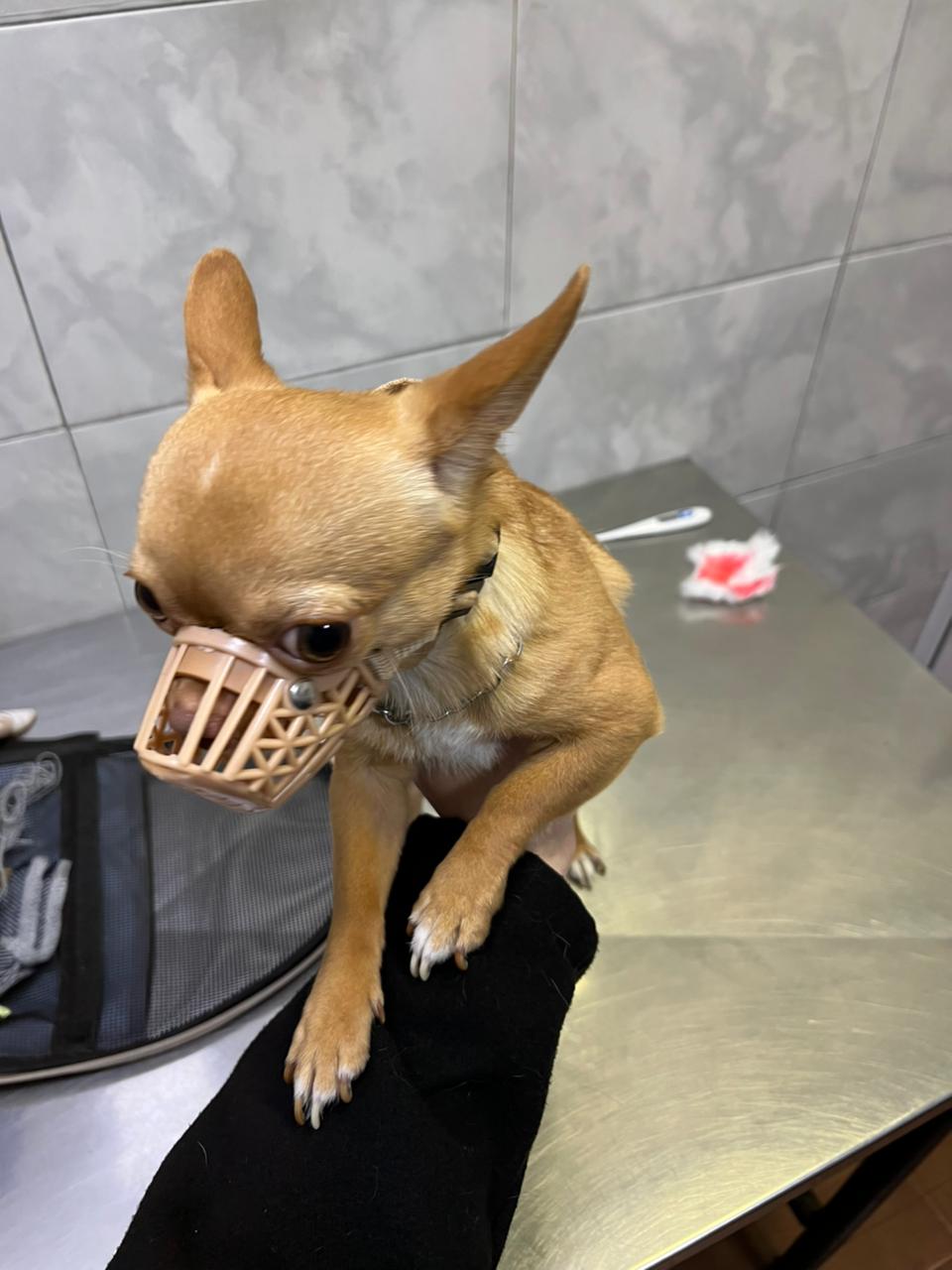
The photo above is Lorenzo wearing a muzzle at the vet. He isn’t aggressive. He’s a 2-year-old Chihuahua who is about to have his knees handled and who, if he gets scared, bites. The muzzle protects him from doing something nobody wants. This article is about how we got that muzzle to be almost decorative.
This article is for general information and is not a substitute for advice from a veterinarian or a veterinary behaviorist. If your dog has already bitten and caused an injury, seek professional help in addition to reading this.
Why did my Chihuahua become aggressive?
It’s almost always one of these five, and they tend to come in pairs:
- Fear. The root cause of nearly all aggression in this breed. A 5-pound dog who feels cornered doesn’t have the option to run: he has the option to attack.
- Lack of socialization. Puppies who never went outside until 5 months “because he was so small,” who never met big dogs, kids or people in hats. Everything he didn’t meet as a baby scares him as an adult.
- Overprotection. Picking him up every time another dog approaches, covering him when people come over, letting him growl from your arms. It teaches him there’s danger and that you are his watchtower.
- Pain. Teeth, knees, ears, spine. An adult Chihuahua who starts growling when touched hasn’t had a personality change: something hurts.
- Resource guarding. Food, bed, a toy and, very typical in Chihuahuas, a person. He growls when anyone gets close to “his” human.
What it isn’t: dominance. The idea of a Chihuahua who “wants to be pack leader” was discarded by behavioral science about twenty years ago, and the methods built on it (pinning him down, the alpha roll, “making him respect you”) are exactly the ones that make fear worse.
How do you read the warning signs before a bite?
A Chihuahua always warns you. The problem is that his warnings are small and fast, and we miss them. In order, from mildest to most serious:
| Signal | What it says | What to do |
|---|---|---|
| Licks his lips, yawns, turns his head away | ”This makes me uncomfortable” | Stop what you’re doing |
| Freezes, eyes wide, whites showing | ”This is scaring me” | Give him space, don’t move closer |
| Low growl | ”Back off, please” | Back off. It’s the clearest and most valuable warning |
| Bares his teeth, sharp bark | ”Last warning” | Back off without touching him |
| Air snap | ”I told you” | Back off |
| Bite | — | Too late this time |
The single most important rule in this whole article: never punish the growl. It’s the emergency brake. A Chihuahua who gets scolded for growling learns that growling doesn’t work, and next time he goes straight to the bite.
What should I do with an aggressive Chihuahua? The plan
Step 0. The vet
Before anything else. Have his mouth, knees, ears and spine checked. In a Chihuahua over 5, dental disease and luxating patella are so common that they always need to be ruled out. If there’s pain, no training will stick until it’s treated.
Step 1. Identify the trigger and the distance
For one week, write down when he reacts: big dogs, men, children, people at the door, being touched, the bed. And at what distance it starts. That distance is your starting point: all the work happens a bit farther away than that.
Step 2. Management: stop the rehearsals
Every time he reacts, he practices reacting. While you work on it, avoid the trigger: cross the street, walk at quiet times, close the curtains, put him in another room with a chew when guests arrive. That isn’t giving up; it’s taking away his practice sessions.
Step 3. Change how he feels (counterconditioning)
This is the heart of the method, and it’s simple, if slow:
- The trigger appears at a safe distance (your dog sees it and doesn’t react).
- At that moment, and only at that moment, amazing treats: chicken, cheese, whatever he loves most. They keep coming as long as the trigger is in sight.
- The trigger disappears, the treats stop.
- Repeat. Dozens of times. For weeks.
Over time, seeing a big dog stops meaning “danger” and starts meaning “chicken.” When, at that safe distance, he looks at you instead of the other dog, move a few feet closer. If he reacts, you went too far: go back to the previous distance.
Step 4. Stop picking him up
Unless there’s real danger (an off-leash dog charging at you), don’t. Picking him up takes him off the ground, keeps him from moving away on his own and confirms that the situation was serious. A step to the side, a cheerful “let’s go” and a change of direction work better than any rescue.
Step 5. Strangers, hands off
The rule for guests and people on the street: don’t touch him. They ignore the dog, drop a treat as they pass and keep going. Let the Chihuahua decide whether to approach, and even then, no hands over his head. When a stranger says “oh, dogs love me” and reaches out, you say no, as firmly as you would to a child.
Step 6. A muzzle, without drama
If there’s a risk of biting (the vet, the groomer, visits with kids), a fabric or basket muzzle is a tool, not a punishment. You teach it with treats: muzzle on for one second, treat; two seconds, treat; starting a week before you need it. A dog who’s comfortable in a muzzle can be handled calmly, and calm lowers aggression. It’s what we did with Lorenzo for his checkups.
Aggression toward other dogs
It’s the most common kind on walks and the most absurd to watch: 5 pounds of Chihuahua trying to eat a German Shepherd. It’s fear on a leash: he can’t run away, so he attacks. Trainers call it leash reactivity. What helps:
- A harness and a loose leash. A tight leash passes your tension down to him and keeps him from creating distance. And in a Chihuahua, a collar is a tracheal hazard on top of an anxiety trigger.

AIITLE step-in harness in true Chihuahua sizes
★4.4 · 3,364ratings
It goes down to an 8.5-inch chest, for dogs under 4 pounds, and spreads the pull across the chest instead of the neck: in a reactive dog who lunges forward, that's the difference between a scare and a damaged trachea.
Heads-up:A buyer with two Chihuahuas warns it isn't escape-proof: her male pulled his front legs out even when it was snug. For a dog who backs up in a panic, check the fit before every walk.
See the harness on Amazon →- Cross early, not late. When you spot the other dog 100 feet away, cheerfully switch sides of the street. Don’t make him walk right past “so he gets used to it”: he won’t get used to it, he’ll get more sensitized.
- Calm dogs, one at a time. One meeting with a calm adult dog, in an open space, on loose leashes, is worth more than twenty in the vet’s waiting room.
The whole process, for puppies and adults, is in how to socialize a Chihuahua.
Aggression toward family
It’s the most painful kind and the one people hide most. It’s almost always guarding (the bed, the couch, a person) or fear of handling (being picked up, nail trims, the harness). You work on it with trades and gradual, rewarded handling; we cover the details in Chihuahua biting: why he bites and how to stop it. If the dog bites someone in the household hard enough to draw blood, or if there are young children, bring in a veterinary behaviorist from day one.
When should you call a professional?
- He has already bitten and broken skin, even slightly.
- The aggression is aimed at people in the household, or there are kids.
- It started suddenly in an adult (after seeing the vet).
- You’ve followed the plan for a month and there’s no improvement.
Look for a positive-reinforcement trainer or a veterinary behaviorist. If the professional talks about “hierarchy” or “dominance,” or suggests prong or shock collars, find a different professional: in a fearful dog that makes things worse, and the evidence is overwhelming.
How long does it take to improve?
The first signs come in two or three weeks: he reacts later, more briefly, at a shorter distance. A solid change takes two to four months. And in dogs with years of practice, the work is lifelong: not because they don’t improve, but because a Chihuahua who was once fearful will always need you to read his warnings.
Lorenzo and the decorative muzzle
Lorenzo is 2 years old and has more than a year of work behind him: he went from air-snapping when anyone touched his paws to letting the vet check his knees in a muzzle that barely needs fastening anymore. On walks he still flags big dogs, but now it’s one bark and a look up at me, which is exactly what we taught him: “I saw the danger, what do we do?” Chicken, and on we go.
What these dogs are really like on the inside, beyond the myth of the hysterical Chihuahua, is in the real Chihuahua temperament. And if he barks but doesn’t bite, that’s a different problem with a different fix: Chihuahua barking.
🔗 The product card in this article contains an Amazon affiliate link. If you buy through it, we earn a small commission that keeps the club free. It doesn’t raise your price, and it doesn’t change what we recommend — the drawback in the card is there for exactly that reason. It sends you to your country’s Amazon store.
Frequently asked questions
Why are Chihuahuas so aggressive?
How do I fix an aggressive Chihuahua?
My Chihuahua is aggressive toward strangers. Is that normal?
Can an aggressive Chihuahua be cured?
Should I neuter an aggressive Chihuahua?
Written by Belen Salto, who shares her life with Romeo and Lorenzo, two Chihuahuas. · Ver en español